





Why Is My Jaw Crusher Producing Less Material? Causes and Solutions | HAMAC
Is your jaw crusher producing less material than expected?
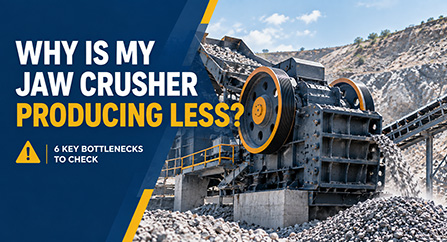
Low output does not always mean that the jaw crusher itself is damaged or undersized. The actual cause may be unstable feeding, oversized rock, an unsuitable closed side setting (CSS), worn jaw plates, excessive fines, wet or clay-rich material, bridging, or a bottleneck in the discharge conveyor, screen or stockpile area.
This guide explains the most common causes of low jaw crusher production and provides practical checks for quarry operators, mining companies, aggregate producers, road contractors, recycling plants, maintenance teams and equipment buyers.
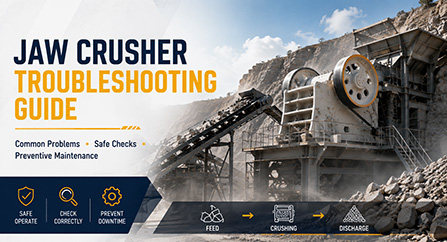
If you need a broader review of blockage, abnormal vibration, bearing overheating, jaw plate wear, drive problems and preventive maintenance, read HAMAC’s Jaw Crusher Troubleshooting Guide.
Important: Always follow the operating and maintenance manual for your specific crusher model. CSS adjustment, jaw plate replacement, chamber inspection, lifting work and electrical or mechanical maintenance must be performed by trained personnel using approved site safety procedures.
Quick Diagnosis: Why Is My Jaw Crusher Producing Less?
| Possible Cause | Typical Sign | What to Check | Corrective Direction |
|---|---|---|---|
| Uneven or unstable feeding | Production fluctuates; crusher alternates between empty running and overload | Feeder rate, hopper flow, feed centering and bridging | Use a stable, controlled and evenly distributed feed |
| Oversized feed | Bridging, blockage, high load or repeated stoppage | Largest rock size compared with the crusher’s permitted feed size | Control blasting, screening, breaking and loader practices |
| CSS too small | Finer product but lower TPH, higher power demand or faster wear | Current CSS and required downstream feed size | Use the largest approved CSS that meets product requirements |
| Worn jaw plates | More material slippage, coarse product, reduced gripping and uneven wear | Jaw plate profile, thickness, cracks and wear pattern | Rotate or replace only when permitted by the manual and equipment design |
| Excessive fines or clay | Packing, chamber buildup, reduced flow and discharge blockage | Fine fraction, soil, clay and natural moisture | Consider scalping or pre-screening where appropriate |
| Wet or sticky material | Material sticks to chutes, screens or the crushing chamber | Moisture, clay content and transfer-point buildup | Improve material preparation, water management and flow design |
| Downstream bottleneck | Crusher backs up or stops even though it is mechanically sound | Discharge conveyor, screen, transfer chute and stockpile area | Balance the complete crushing and screening circuit |
| Material characteristics have changed | Production decreases after changing quarry bench, mine zone or feed source | Hardness, abrasiveness, density, moisture and gradation | Review settings, wear parts and process configuration |
| Crusher is undersized | All operating conditions are correct but average TPH remains below target | Full process capacity and long-term production data | Consider a larger crusher or redesigned plant layout |
1. Uneven or Unstable Feeding
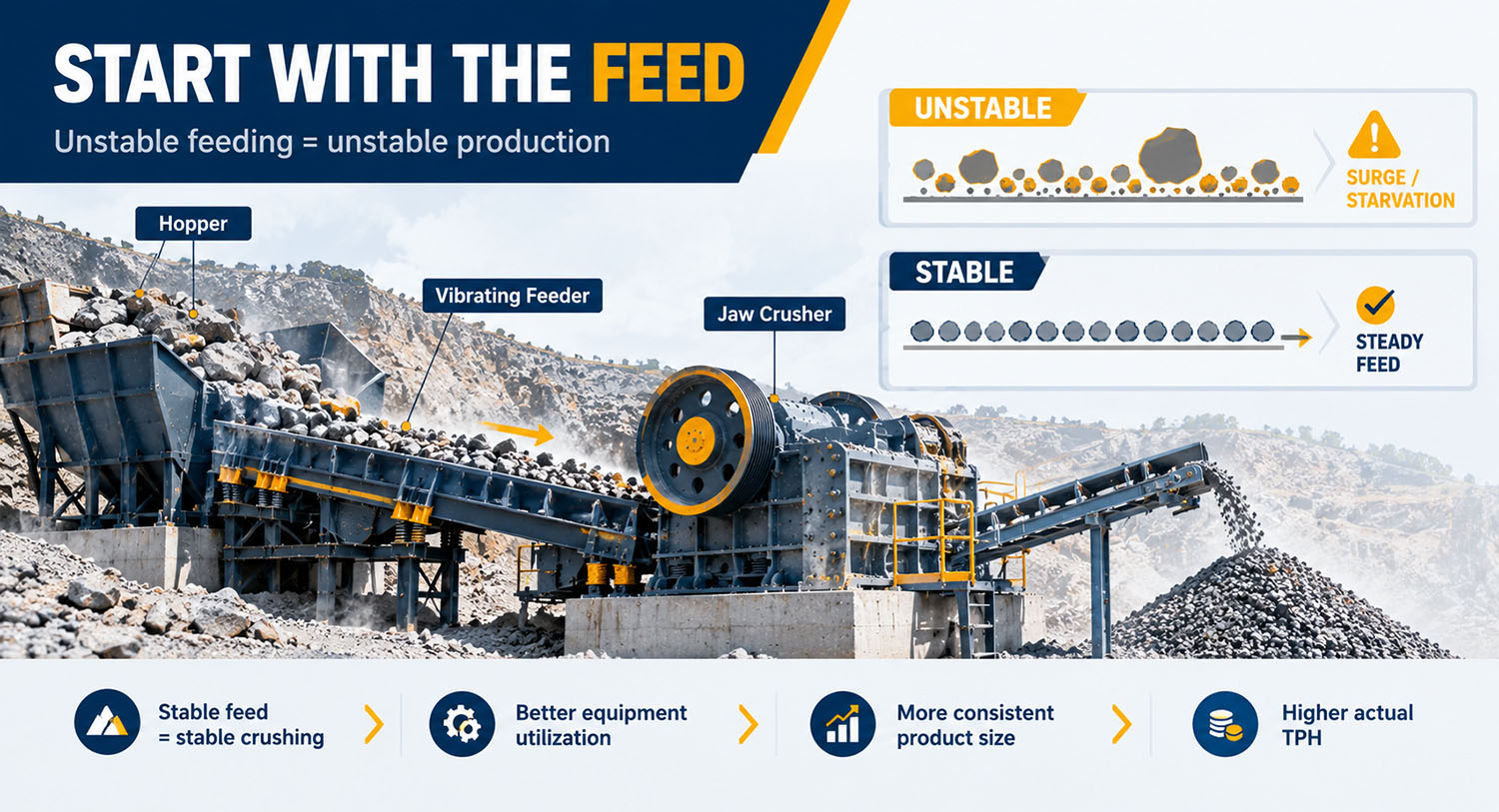
A jaw crusher normally performs more consistently when it receives a steady and evenly distributed feed. If the machine runs empty for several minutes and then receives a large surge of material, the average production rate may be much lower than the crusher’s potential capacity.
Sandvik states that optimum jaw crusher performance requires a good feed level and homogeneous feed. HAMAC’s vibrating feeder range is designed to deliver material continuously and evenly from the hopper to the crusher, with published capacity ranges from approximately 90 to 900 T/H depending on model and operating conditions.
Signs of Unstable Feeding
- The crusher runs with an almost empty chamber for extended periods.
- The motor load rises and falls sharply.
- The feeder stops frequently because of hopper bridging.
- Material enters mainly on one side of the crushing chamber.
- Large rocks arrive in sudden batches.
- Production varies significantly from one hour to the next.
- One side of the jaw plate wears faster than the other side.
How to Improve Feed Stability
Check whether the feeder is correctly sized for the jaw crusher. Confirm that the hopper can maintain a sufficient material level without bridging and that the feed chute directs material toward the centre of the crushing chamber.
For a vibrating feeder, check the actual feed rate rather than only the feeder model’s maximum capacity. The feeder must match the crusher, material characteristics and required production rate. A feeder that is too small may starve the crusher, while uncontrolled surges from an oversized feeder may create overloads.
Use a safe observation point to check whether the material enters evenly. Do not stand on, reach into or approach an unguarded feeder, hopper or crushing chamber during operation.
For more information about HAMAC feeding equipment, see the HAMAC Vibrating Feeder.
2. Oversized Feed and Material Bridging
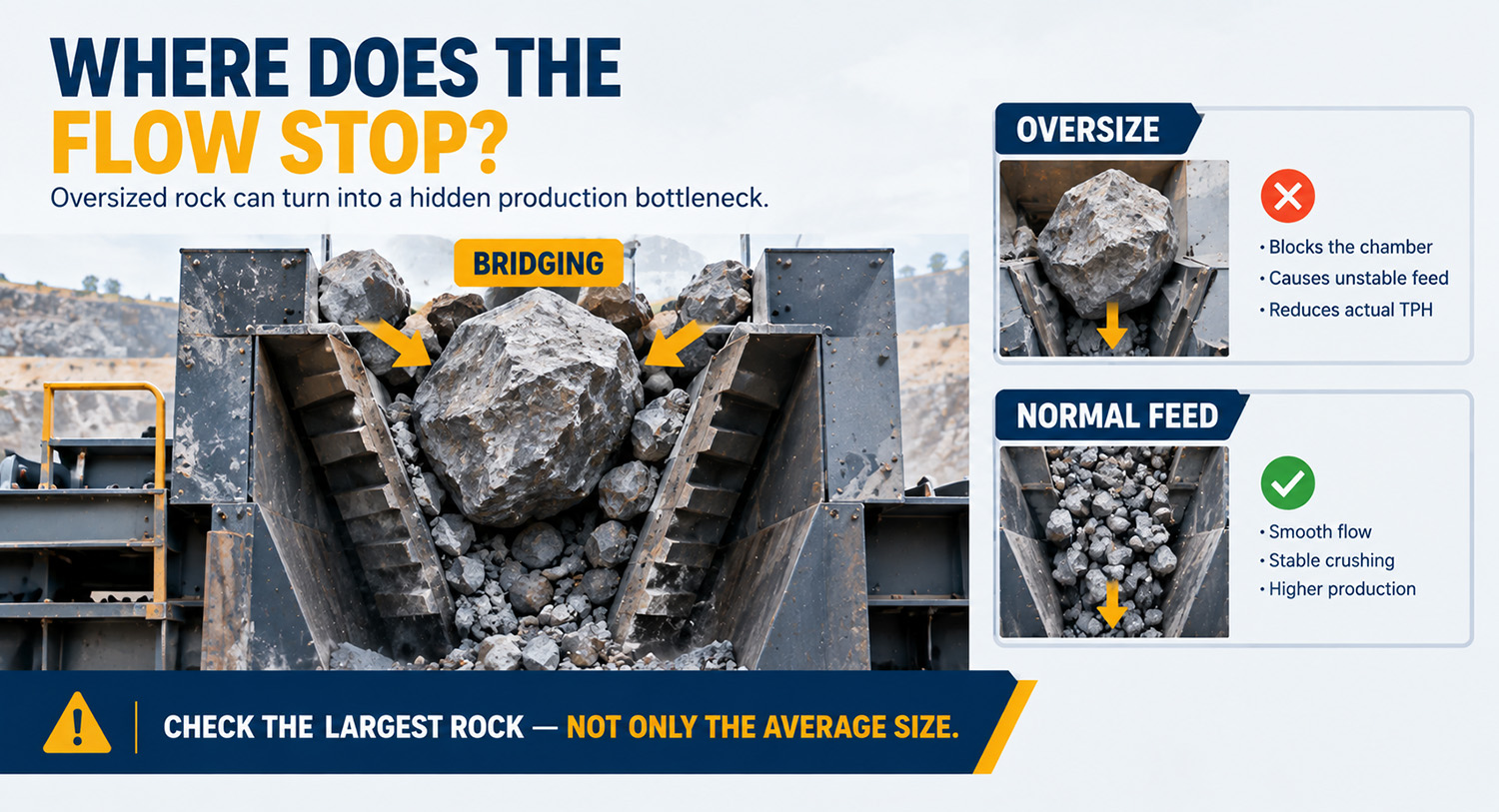
Oversized feed is one of the most common causes of low jaw crusher output. A large or irregular rock can bridge across the feed opening or become wedged against other rocks, blocking the flow into the chamber.
What Is Jaw Crusher Bridging?
Bridging occurs when one oversized rock, several crossing rocks or an unfavourable feed shape prevents material from passing normally through the feed opening. The crusher may continue running, but the crushing chamber is no longer receiving a stable feed.
Bridging can cause:
- Lower average TPH.
- Sudden overload or motor trips.
- Repeated operator intervention.
- Unstable jaw plate loading.
- Greater risk of damage to toggle components and wear parts.
- Long periods of non-productive running time.
How to Reduce Bridging Risk
- Measure the largest expected feed rock, not only the average rock size.
- Control blasting and excavation practices to reduce oversize boulders.
- Separate or break oversize material before it reaches the primary crusher.
- Check whether the feed chute encourages rocks to cross or wedge.
- Use a correctly selected grizzly or scalping arrangement where appropriate.
- Train the loader operator to avoid sudden uncontrolled feed surges.
- Keep the discharge path open so material can leave the crusher continuously.
Metso’s crushing handbook recommends avoiding oversized boulders entering the feeder and crusher cavity wherever possible. It also explains that the maximum feed size should generally be considered in relation to the crusher intake opening and the operating conditions of the feeder and plant.
Read Metso’s guidance on improving jaw crusher performance and preventing bridging.
3. Maximum Feed Size and Feed Distribution
A jaw crusher’s maximum feed size is not the same as the average feed size. A plant may appear to process material of a suitable average size while occasional large or irregular pieces continue to create bridging, overload and downtime.
HAMAC’s PE Series jaw crushers list maximum feed sizes from approximately 210 mm for smaller PEX models to approximately 1020 mm for the PE1200×1500 model. The appropriate value depends on the selected model and must be confirmed against the technical data for the actual machine.
| HAMAC Model | Feed Opening | Maximum Feed Size | Reference Capacity | Reference Output Range |
|---|---|---|---|---|
| PEX250×750 | 250×750 mm | 210 mm | 13–35 T/H | 25–60 mm |
| PEX250×1000 | 250×1000 mm | 210 mm | 16–52 T/H | 25–60 mm |
| PE400×600 | 400×600 mm | 340 mm | 16–60 T/H | 40–100 mm |
| PE500×750 | 500×750 mm | 425 mm | 40–110 T/H | 50–100 mm |
| PE600×900 | 600×900 mm | 500 mm | 80–180 T/H | 65–180 mm |
| PE750×1060 | 750×1060 mm | 630 mm | 110–320 T/H | 80–180 mm |
| PE900×1200 | 900×1200 mm | 780 mm | 220–450 T/H | 95–225 mm |
| PE1000×1200 | 1000×1200 mm | 850 mm | 280–550 T/H | 195–280 mm |
| PE1200×1500 | 1200×1500 mm | 1020 mm | 400–800 T/H | 150–300 mm |
Important: The values above are HAMAC reference data, not guaranteed site production. Actual output depends on rock type, feed gradation, moisture, abrasiveness, CSS, jaw plate condition, feeding stability, power and downstream equipment capacity.
For detailed model selection and current technical specifications, visit the HAMAC PE Series Jaw Crusher page.
4. CSS Is Too Small or Not Suitable for the Product
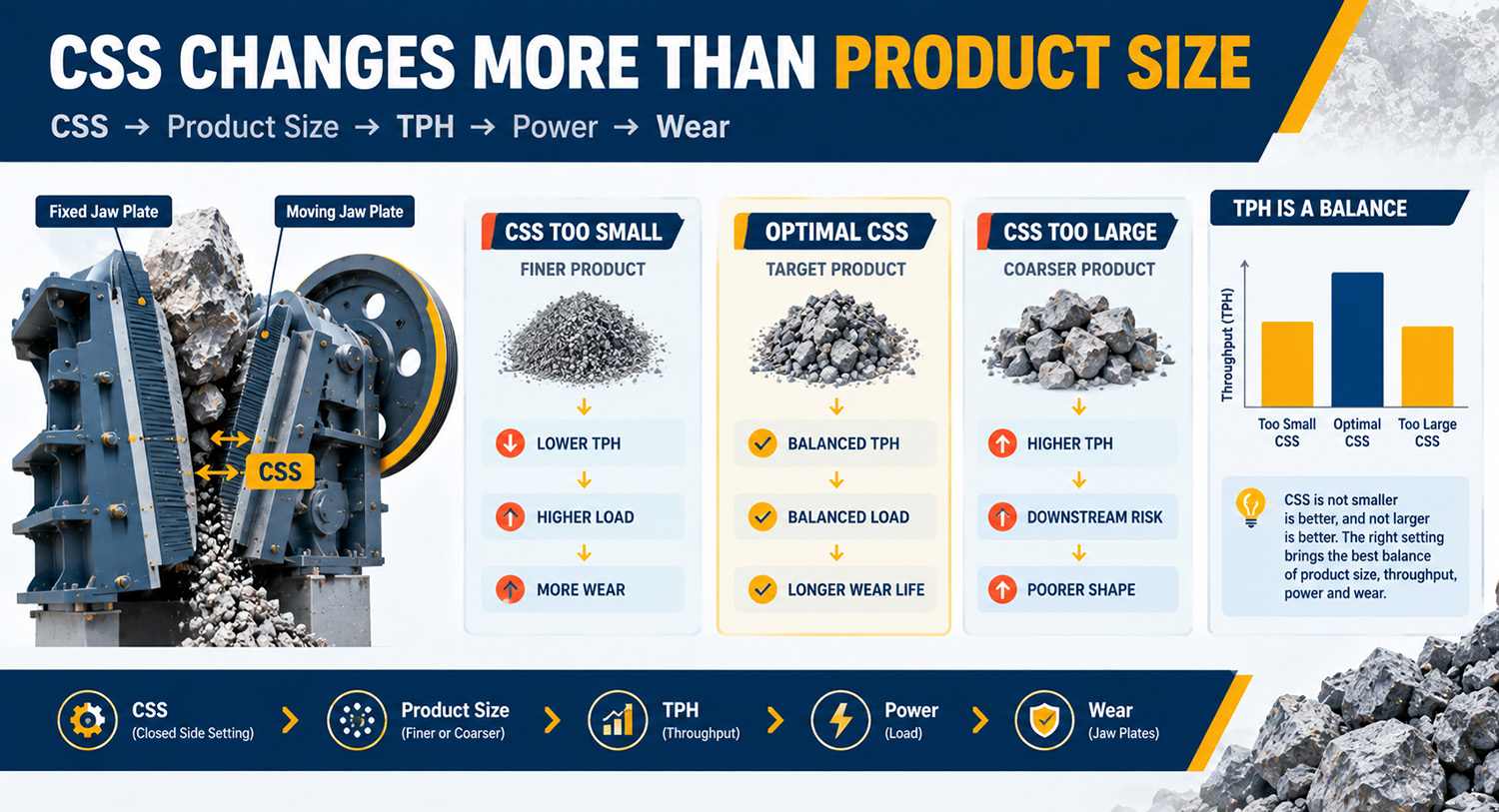
The closed side setting, commonly called CSS, is the minimum distance between the fixed and moving jaw plates during the crushing cycle. CSS affects the maximum product size, crushing load, power demand, throughput and wear rate.
A smaller CSS generally produces a finer product, but it can also reduce throughput and increase crushing forces. If the customer only needs a suitable feed size for the next crusher or screen, setting the jaw crusher unnecessarily tight may reduce the total plant capacity.
Common CSS-Related Problems
| CSS Condition | Possible Result |
|---|---|
| CSS too small | Finer product, lower TPH, higher load, higher power demand and faster wear. |
| CSS too large | Higher possible throughput but coarser discharge product and possible downstream overload. |
| CSS not measured correctly | Actual product size and capacity may differ from the operator’s assumption. |
| CSS changes as jaw plates wear | Product size, chamber profile and crushing efficiency may gradually change. |
| CSS does not match downstream equipment | The jaw crusher or the next stage may become the plant bottleneck. |
How to Select a Practical CSS
Start with the required final product size and the maximum feed size accepted by the next processing stage. Then use the largest approved CSS that can still meet the product requirement. This often provides a better balance between jaw crusher capacity, product size, power consumption and wear.
Never change the CSS while the crusher is operating unless the machine is specifically designed for that adjustment and the procedure is authorized by the manufacturer. Follow the applicable HAMAC manual and site safety procedure.
Sandvik’s jaw crusher technical information demonstrates that crusher capacity varies with CSS, feed condition and the amount of fines included or removed from the feed. Its published capacities are based on defined test conditions, which shows why catalogue TPH should not be treated as a universal guarantee for every material and setting.
5. Worn or Incorrect Jaw Plates
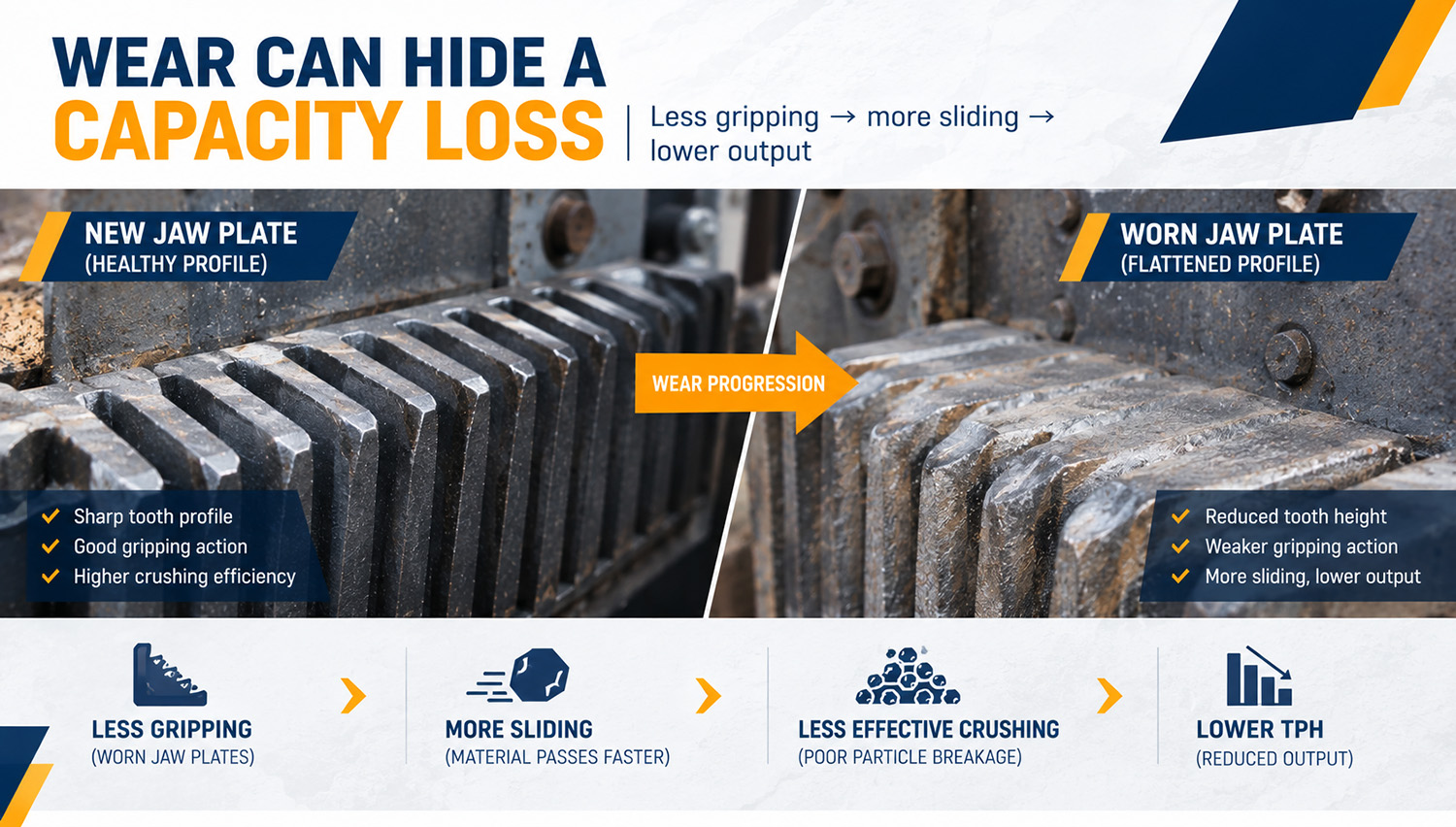
Jaw plates are directly involved in gripping and compressing the feed material. As the tooth profile wears, the crusher may lose its ability to grip material effectively. The result can be more sliding, less effective reduction, a changed crushing angle, coarser product and lower output.
Signs That Jaw Plate Wear Is Reducing Production
- Actual TPH declines while feed material and CSS remain comparable.
- More material appears to slide instead of being gripped.
- The discharge product becomes coarser or less consistent.
- The operator must reduce CSS to maintain product size.
- The lower section of the plate is heavily worn.
- One side of the plate wears much faster than the other.
- Cracks, chipped teeth or deformation are visible.
- Jaw plate replacement intervals become shorter.
How to Monitor Jaw Plate Condition
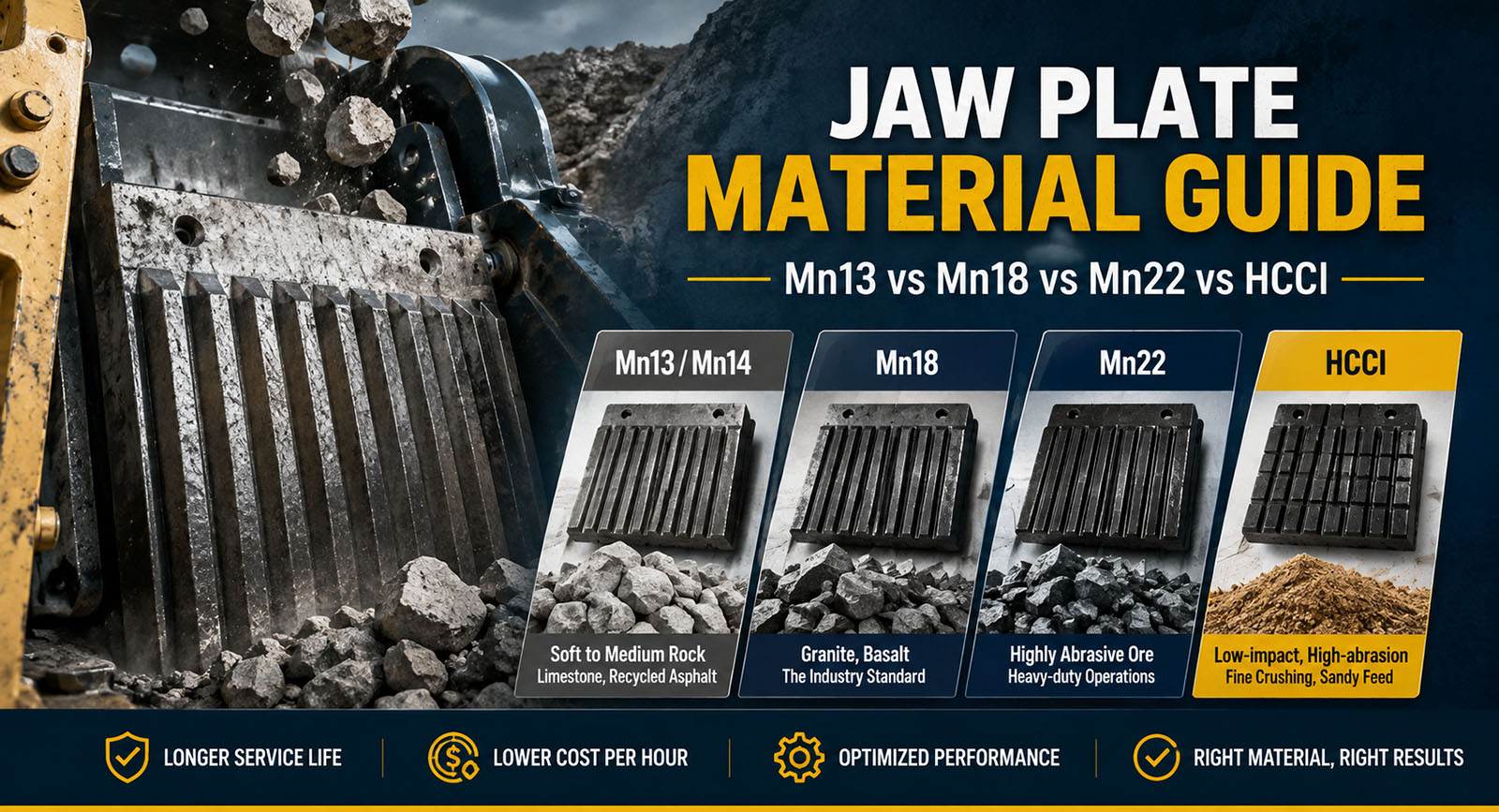
Record operating hours, tonnes processed, material type, CSS, jaw plate thickness, wear pattern and average TPH. A calendar-based replacement interval is less reliable than a condition-based plan because granite, basalt, iron ore, limestone and recycled concrete can produce very different wear rates.
Uneven wear often indicates a feed-distribution problem. Inspect whether the feed enters the centre of the crushing chamber and whether large or highly abrasive particles repeatedly fall on one side.
Do not rotate, reverse or replace jaw plates unless the specific HAMAC equipment design and manual permit the procedure. Jaw plates are heavy components and must be handled with approved lifting equipment and trained personnel.
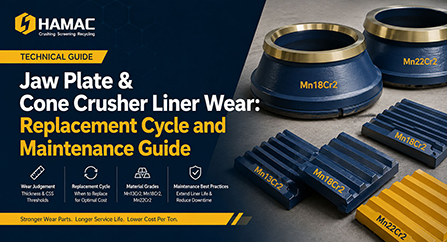
For a detailed review of jaw plate wear, manganese grades and replacement planning, read HAMAC’s Jaw Plate and Cone Crusher Liner Wear Replacement Guide.
For general information about jaw plate profiles, wear-part selection and the relationship between wear condition and crusher productivity, see the Metso jaw crusher wear parts overview.
6. Excessive Fines, Clay or Wet Material
Natural fines, soil, clay and wet feed can reduce effective jaw crusher capacity. Fine material may fill spaces between larger rocks, while sticky material may build up in the chamber, feed chute, discharge opening, screen or transfer point.
How Fines Affect Jaw Crusher Output
- Fines may occupy chamber volume without requiring the same crushing effort as large rock.
- Clay may bind fine and coarse particles together.
- Wet material may stick to chutes and screens.
- Material flow may become irregular.
- Discharge areas may pack or block.
- Downstream screens may blind or lose effective screening area.
Depending on the feed material and final-product requirements, a grizzly feeder or scalping screen may remove excessive fines before primary crushing. This is not automatically the best solution for every plant; the decision should consider material gradation, moisture, clay content, required product size and the economics of the complete process.
Recommended Checks for Wet or Clay-Rich Feed
| Check | Question to Ask |
|---|---|
| Feed material | Has the material source changed after rain, excavation depth or a new quarry bench? |
| Clay content | Is clay binding the material and reducing free flow? |
| Feeder grizzly | Can natural fines pass through before reaching the crusher? |
| Discharge chute | Is material sticking to the chute or building up below the crusher? |
| Screen surface | Is wet material blinding the screen and restricting the plant? |
| Water management | Is water entering the hopper, transfer point or stockpile area? |
Do not enter a blocked chamber, hopper or chute to remove material without complete shutdown, isolation and authorization under the site’s safety procedure.
7. The Discharge Conveyor or Screen Is the Real Bottleneck
A jaw crusher can be mechanically capable of producing more material while the complete plant still produces less. The bottleneck may be the discharge conveyor, transfer chute, screen, secondary crusher, stockpile or loading system.
Metso’s process-planning guidance emphasizes that a crushing plant must be evaluated as an integrated process. Feed properties, feeder capacity, crusher selection, screening, conveying and final product requirements all influence the real production result.
Check the Complete Material Flow
Feeder → Jaw Crusher → Discharge Conveyor → Screen → Product Conveyors → Stockpile or Secondary Crusher
| Downstream Problem | How It Reduces Jaw Crusher Production |
|---|---|
| Discharge conveyor too small | Material backs up below the crusher and forces the operator to slow or stop feeding. |
| Transfer chute blockage | Material cannot leave the crusher continuously. |
| Screen overloaded | The crusher must be slowed down to avoid screen overflow or poor separation. |
| Screen blinding | Wet or sticky material reduces screening efficiency and blocks product flow. |
| Stockpile full | The plant has nowhere to send material, causing unnecessary downtime. |
| Secondary crusher overloaded | The primary jaw crusher must be throttled to protect the next stage. |
| Conveyor belt tracking issue | Safety stoppages, spillage and reduced conveying reliability interrupt production. |
Measure production before and after the jaw crusher. If the jaw crusher discharge is stable but final saleable production is low, the problem is likely in screening, conveying, stockpiling or product-quality control rather than the jaw crusher itself.
For mobile and integrated material-flow solutions, visit HAMAC’s mobile crushing plant solutions and modular crushing plant solutions.
8. Material Characteristics Have Changed
A jaw crusher may produce less material after the quarry bench, mine zone, raw-material source or recycling feed changes. Rock hardness, abrasiveness, crushability, density, moisture, clay content and particle shape all affect actual production.
| Material Change | Possible Effect | What to Review |
|---|---|---|
| Limestone to granite | Higher crushing resistance and possible lower TPH | CSS, motor load, jaw plate profile and feed rate |
| Granite to basalt | Possible change in hardness, abrasiveness and wear rate | Jaw plate material, wear trend and production baseline |
| Clean rock to clay-rich feed | More packing, buildup and blockage risk | Scalping, moisture management and discharge flow |
| Dry feed to wet feed | Reduced material flow and possible screen blinding | Feed chute, screen, transfer points and drainage |
| Uniform feed to mixed-size feed | More fluctuations, segregation and bridging | Hopper, feeder, loader and feed preparation |
| Clean aggregate to recycled concrete | Possible steel, wood, soil and other uncrushable contamination | Pre-sorting, tramp-metal protection and feed preparation |
Do not compare the output of two materials as if they were identical. A crusher’s catalogue capacity is normally based on defined assumptions about material, feed gradation, density, moisture, CSS and operating conditions.
Sandvik’s published capacity data, for example, identifies specific reference conditions such as clean, friable and dry granite with defined density assumptions. This illustrates why a capacity figure must be interpreted together with the feed material and operating setting.
9. Is the Jaw Crusher Undersized?
Buying a larger jaw crusher is not always the first or best solution. A crusher may appear undersized when the real problem is a small feeder, unstable feed, bridging, excessive fines, a tight CSS, worn jaw plates or an overloaded screen.
Consider a larger jaw crusher or plant redesign only after confirming that:
- The feeder supplies material continuously and evenly.
- The maximum feed size is suitable for the selected crusher.
- Oversized rock and uncrushable material are controlled upstream.
- The CSS is correctly selected for the required product size.
- The jaw plates are in acceptable condition.
- Wet, sticky or clay-rich material is properly managed.
- The discharge conveyor can handle the required production rate.
- The screen and downstream crusher can accept the jaw crusher output.
- Downtime and waiting time have been removed from the calculation.
- Actual average saleable TPH still remains below the project target.
If all these conditions are satisfied and production remains below the required level, the project may need a larger jaw crusher, multiple crushers, additional screening, a different crushing stage arrangement or a complete process redesign.
HAMAC’s modular plant information includes reference capacities such as approximately 100–330 T/H, 140–420 T/H and 170–600 T/H for selected modular plant configurations. These figures are also configuration-dependent and should be matched with material, feed size, product requirements and downstream equipment.
Review HAMAC modular crushing plant configurations.
10. Practical Ways to Improve Jaw Crusher Capacity
| Action | Expected Benefit | Data to Monitor |
|---|---|---|
| Stabilize the feed rate | Reduces empty running, surges and load fluctuation | Feeder rate, motor load and hourly TPH |
| Center material in the chamber | Improves jaw plate loading and may reduce uneven wear | Feed pattern and plate wear distribution |
| Control oversize rocks | Reduces bridging, overload and blockage | Maximum feed size and blockage frequency |
| Use an appropriate CSS | Balances product size, throughput, power and wear | CSS, product gradation and motor current |
| Inspect jaw plates regularly | Prevents severe loss of gripping action and unplanned downtime | Thickness, profile, cracks and TPH trend |
| Remove excessive fines when suitable | Reduces packing and improves effective chamber use | Fines percentage and screen performance |
| Manage wet or clay-rich feed | Reduces buildup and discharge restrictions | Moisture, clay, chute buildup and screen blinding |
| Balance conveyors and screens | Prevents downstream backup and forced crusher stoppage | Conveyor loading, screen load and stockpile status |
| Track average saleable TPH | Shows real plant performance instead of peak production | Tonnes, crushing hours and downtime |
| Review repeated failures | Identifies root causes instead of repeatedly replacing parts | Failure history, parts usage and operating conditions |
11. Jaw Crusher Low Production Inspection Checklist
Use the following checklist when actual output is lower than expected. Start with the lowest-risk process checks before arranging mechanical inspection.
| Inspection Order | Question | Result to Record |
|---|---|---|
| 1 | Is the crusher receiving a stable and centred feed? | Stable, intermittent or uneven |
| 2 | Is the maximum feed size within the model’s permitted range? | Largest measured rock size |
| 3 | Has bridging occurred at the hopper or feed opening? | Frequency and duration of each event |
| 4 | Is the feed wet, sticky, clay-rich or excessively fine? | Material condition and estimated fine fraction |
| 5 | Is the CSS suitable for the required product size? | Current CSS and final product size |
| 6 | Are the jaw plates worn, cracked or unevenly loaded? | Wear profile, thickness and visible damage |
| 7 | Is material leaving the discharge opening freely? | Chute, conveyor and stockpile condition |
| 8 | Is the screen accepting the required feed rate? | Screen load, blinding and overflow |
| 9 | Has the source material changed? | Rock type, hardness, abrasiveness and moisture |
| 10 | Are vibration, noise, bearing temperature or overload alarms present? | Trend data and maintenance findings |
12. When to Stop the Jaw Crusher
Stop the jaw crusher and follow the site shutdown and isolation procedure if you observe sudden severe vibration, persistent knocking, smoke, burning smell, visible cracks, damaged guards, a suspected bearing failure, repeated overload trips, damaged flywheels, broken toggle components or a blockage that cannot be safely cleared.
Never enter the crushing chamber, reach into the feed opening or remove material from a chute while the equipment is energized or capable of movement. Use the applicable lockout/tagout procedure and allow all stored mechanical energy to dissipate before inspection.
For general hazardous-energy-control requirements, consult the OSHA Control of Hazardous Energy Standard.
13. Information to Send HAMAC for a Capacity Review
If your jaw crusher is producing less material than expected, send HAMAC structured information instead of only writing “the output is low.” The following data can help the technical team identify whether the limitation is related to the crusher, material, feed system, wear parts or downstream process.
| Information | Why It Helps |
|---|---|
| Crusher model and serial number | Identifies the equipment configuration and applicable technical data. |
| Material type | Helps evaluate hardness, abrasiveness, crushability and moisture. |
| Maximum feed size | Helps evaluate bridging and overload risk. |
| Average feed size and gradation | Shows whether the crusher is receiving excessive fines or oversize. |
| Current CSS | Helps compare product requirements with the operating setting. |
| Expected TPH and actual average TPH | Quantifies the capacity gap. |
| Final product size requirements | Shows whether the crusher is being operated unnecessarily tight. |
| Jaw plate photos | Helps identify wear profile, cracks and uneven loading. |
| Feed and discharge photos | Helps identify flow restrictions, buildup and poor material distribution. |
| Process layout | Helps identify feeder, conveyor, screen and stockpile bottlenecks. |
| Motor current or power trend | Helps identify underfeeding, overload and feed fluctuation. |
| Downtime history | Shows how much output is lost through blockage, waiting and maintenance. |
Need help diagnosing low jaw crusher output? Send HAMAC your crusher model, material, maximum feed size, CSS, target TPH, actual TPH, jaw plate photos and crushing-plant layout. HAMAC can help review the likely bottleneck and recommend a practical direction for improving production.
Request a Jaw Crusher Capacity Review from HAMAC
14. External Technical References for Jaw Crusher Capacity and Output
The following technical references provide additional information about jaw crusher feed rate, chamber loading, CSS, maximum feed size, bridging, fines, jaw plate wear and downstream screening capacity. Each link opens in a new browser window.
Jaw Crusher Feed Rate and Chamber Loading
Metso recommends maintaining a full and evenly distributed crushing chamber to support stable capacity and improve wear-part utilization. Its jaw crusher wear-parts application guide also explains that oversized feed can reduce capacity, while uneven feeding can reduce capacity, increase wear and increase crushing forces.
Read Metso’s Nordberg C Series Jaw Crusher Wear Parts Application Guide
For additional information about continuous and homogeneous feeding, see the Sandvik jaw crusher technical specification, which explains the importance of a suitable feed level and uniform feed distribution for optimum performance.
View the Sandvik Jaw Crusher Series Technical Specification
Jaw Crusher CSS, Product Size and Throughput
Closed side setting (CSS), maximum feed size, feed gradation and the percentage of fines all affect jaw crusher capacity and product size. Sandvik’s technical specification provides example CSS ranges, feed openings, maximum feed sizes and capacity tables for different jaw crusher models.
Review Sandvik Jaw Crusher CSS, Feed Size and Capacity Data
Metso’s Crushing and Screening Handbook provides broader guidance on crusher feed conditions, maximum feed size, plant loading and the relationship between crusher settings and overall crushing-process performance.
Download the Metso Crushing and Screening Handbook
Jaw Crusher Bridging, Oversize Feed and Blockage Prevention
Oversized or irregular feed can bridge the jaw crusher opening, block the flow of material and reduce production even when the crusher is mechanically operating. Metso recommends controlling oversize material before it reaches the crusher and maintaining a stable feed arrangement.
Read Metso’s Guide to Improving Jaw Crusher Performance and Productivity
Metso also explains that oversized feed can create blockages in the crusher cavity, restrict the complete crushing process and result in unplanned downtime. This is particularly relevant when a plant experiences repeated bridging or sudden production losses.
Read Metso’s Guide to Crusher Selection, Maintenance and Oversized Feed Control
Crushing Plant Conveyor, Screen and Downstream Capacity
A jaw crusher may be capable of producing more material, while the actual plant output remains low because of an overloaded screen, blocked transfer chute, insufficient conveyor capacity or limited stockpile space. Screening can become the bottleneck when the screen is overloaded, blinded by wet material or unable to handle the required feed rate.
Read Metso’s Six Tips for More Efficient Aggregate Screening
For a complete view of crusher, feeder, screen, conveyor and product-flow capacity, use the Metso Crushing and Screening Handbook as a process-design reference. The handbook discusses plant loading, feed conditions and the need to leave sufficient capacity within earlier crushing stages to maintain stable overall production.
View the Metso Crushing and Screening Handbook for Complete Plant Capacity Guidance
15. Frequently Asked Questions
Why is my jaw crusher producing less material?
The most common causes are unstable feeding, oversized material, bridging, an unsuitable CSS, worn jaw plates, excessive fines, wet or clay-rich material, blocked discharge flow or a downstream conveyor and screening bottleneck.
Can a smaller CSS reduce jaw crusher capacity?
Yes. A smaller CSS generally produces a finer product, but it may also increase crushing load, power demand and wear while reducing throughput. Use the largest approved CSS that meets the required product and downstream feed specifications.
Can worn jaw plates reduce jaw crusher output?
Yes. Worn jaw plates can lose their tooth profile and gripping ability, causing more sliding and less effective crushing. A sustained production decrease under comparable feed and CSS conditions should trigger a jaw plate inspection.
Why does wet or clay-rich material reduce jaw crusher capacity?
Wet and clay-rich material can stick to the chamber, chute, screen and transfer points. It can also cause packing, reduce material flow and create discharge restrictions. Pre-screening, improved material preparation and better water management may help depending on the application.
How does feed size affect jaw crusher production?
Feed that is too large or irregular can bridge the opening, increase overload risk and create downtime. Feed size must be evaluated using the largest expected rock, not only the average particle size.
Why is my jaw crusher running but the plant output is low?
The crusher may be running without receiving enough material, or the downstream conveyor, screen, transfer chute, secondary crusher or stockpile may be limiting the plant. Measure production at different stages of the process to locate the bottleneck.
How can I improve jaw crusher throughput?
Stabilize and centre the feed, control oversize, select a suitable CSS, inspect jaw plates, manage fines and clay, keep the discharge path open and confirm that the conveyor and screen can handle the required production rate.
When should I consider a larger jaw crusher?
Consider a larger crusher only after confirming that feeding, maximum feed size, CSS, jaw plate condition, material preparation and downstream equipment are not limiting production. If average saleable TPH remains below target after these checks, a larger crusher or redesigned process may be appropriate.
16. Related HAMAC Jaw Crusher Resources
- HAMAC PE Series Jaw Crusher
- HAMAC European Tech Jaw Crusher
- HAMAC Vibrating Feeder
- HAMAC Modular Crushing Plant
- HAMAC Mobile Crushing Plants
- Jaw Crusher Troubleshooting Guide
- Jaw Plate Wear and Replacement Guide
- Contact HAMAC for Jaw Crusher Technical Support
17. Request a Jaw Crusher Capacity Review
Low jaw crusher output is not always solved by buying a larger crusher. The real limitation may be feed control, maximum feed size, CSS, jaw plate wear, fines, moisture, clay, bridging, conveyor capacity or screening performance.
Send HAMAC your material type, maximum feed size, target TPH, actual TPH, CSS, jaw plate condition and process layout. Our technical team can help identify the likely bottleneck and recommend a practical crushing solution.