



Jaw Plate & Cone Crusher Liner Wear: Replacement Cycle and Maintenance Guide | HAMAC
Jaw Plate and Cone Crusher Liner Wear: Replacement Cycle and Maintenance Guide
Deciding when to replace a jaw plate or a cone crusher liner is a financial balancing act. Replace it too early and you waste usable manganese steel. Replace it too late and you risk cracking the liner, damaging the adjustment ring, or putting excess stress on the main shaft and frame — repairs that can cost far more than the wear part itself.
This guide walks through concrete thickness thresholds, wear-rate benchmarks by material type, manganese steel grade selection, and a practical inspection schedule for both jaw crushers and cone crushers, so you can plan replacements around data instead of guesswork. You can also browse HAMAC's spare parts and wear parts range for OEM-matched jaw plates, mantles and concaves.
Why This Decision Is Harder Than It Looks
Picture an operator who keeps pushing a cone crusher's concave past its wear limit to avoid a shutdown. The liner eventually thins to the point where it cracks under load, and metal-on-metal contact damages the crusher's adjustment ring and mainframe — turning a routine liner swap into a multi-week repair costing many times the price of a replacement liner set.
The opposite mistake is just as costly: swapping out jaw plates or mantles while 20–30% of usable wear life still remains, which quietly inflates wear-part spend without any gain in safety or output. The goal of this guide is to help you find the point in between — replace at the right time, based on measurable signals rather than a fixed calendar.
Jaw Plate Wear: Material Grades and What They Mean for Lifespan
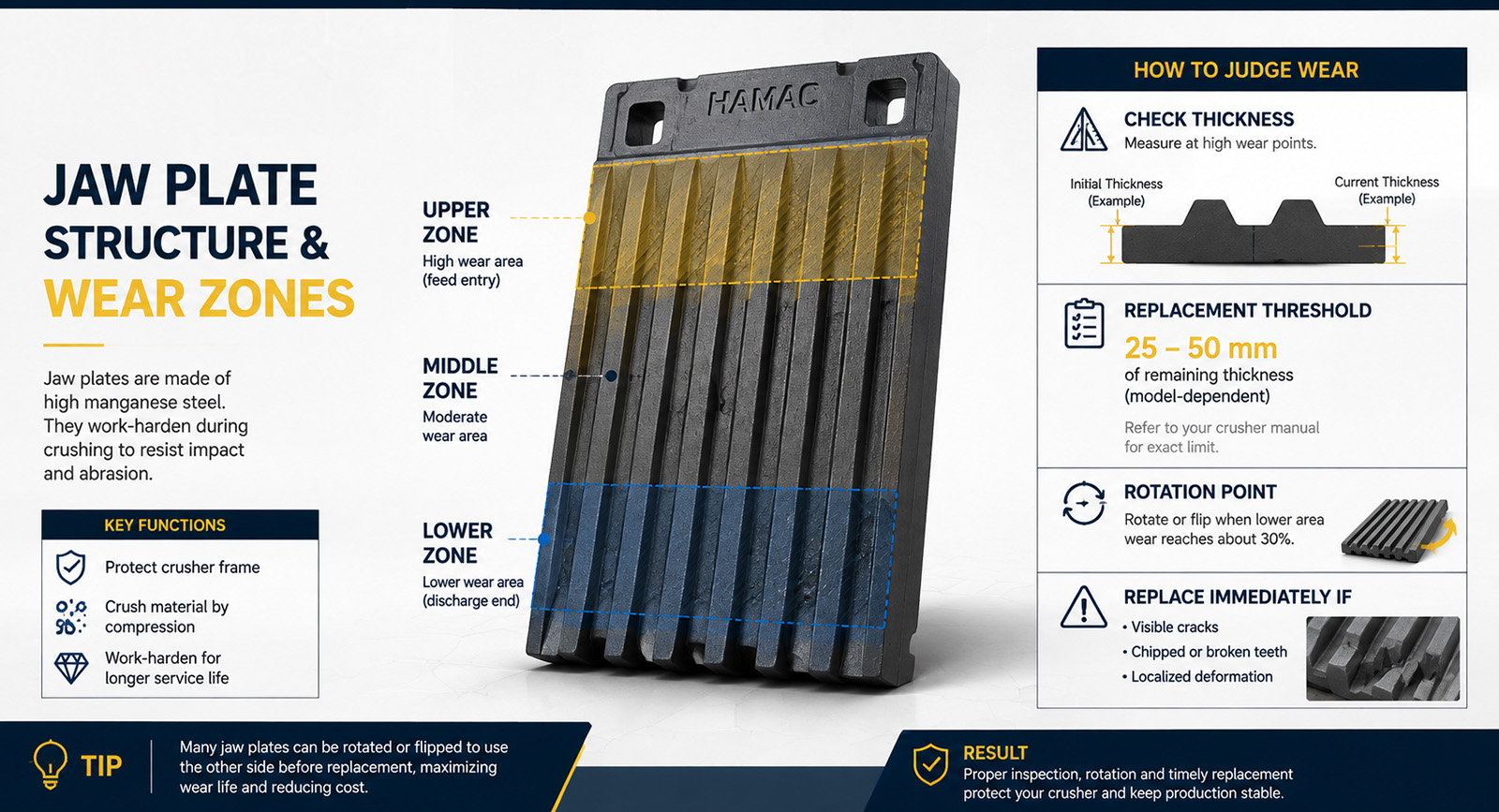
Jaw plates for machines like HAMAC's European Tech. jaw crusher series are typically cast from high-manganese (Hadfield) steel, an austenitic alloy that work-hardens under repeated impact — a metallurgical behavior documented in published wear research on liner wear in jaw crushers. The manganese-chromium grade selected has a direct, measurable effect on service life.
| Grade | Composition | Hardness (initial → work-hardened) | Best suited for | Typical operating lifespan |
|---|---|---|---|---|
| Mn13Cr2 | 12–15% Mn, 1.7–2.2% Cr | ~220–230 BHN → up to 400 BHN | Limestone, coal, softer aggregates, recycled concrete | 400–600 hours in soft rock, up to 4,000–6,000 hours in favorable conditions |
| Mn18Cr2 | 17–19% Mn, 1.8–2.2% Cr | ~230–240 BHN → up to 420–550 BHN | Granite, basalt, quartzite — standard quarry hard rock | 8,000–12,000 hours; 30–40% longer wear life than Mn13Cr2 |
| Mn22Cr2 | 21–23% Mn, 1.8–2.2% Cr | ~240–250 BHN → up to 450–580 BHN | Quartz, taconite, extremely hard and abrasive rock | 10,000–12,000+ hours under optimal conditions |
As a quick selection rule: use Mn13Cr2 as the cost-effective baseline for limestone and general aggregate, move up to Mn18Cr2 for granite and basalt where the extra impact energy properly activates work-hardening, and reserve Mn22Cr2 for extreme-duty, high-tonnage operations where the premium cost is justified by abrasiveness alone. Using a grade higher than your material requires wastes money, since the added manganese only pays off when impact energy is sufficient to work-harden it. If you are unsure which grade fits your rock type, see our guide on choosing crushing equipment by material type.
Jaw Plate Replacement Cycle: When to Actually Swap or Rotate Plates
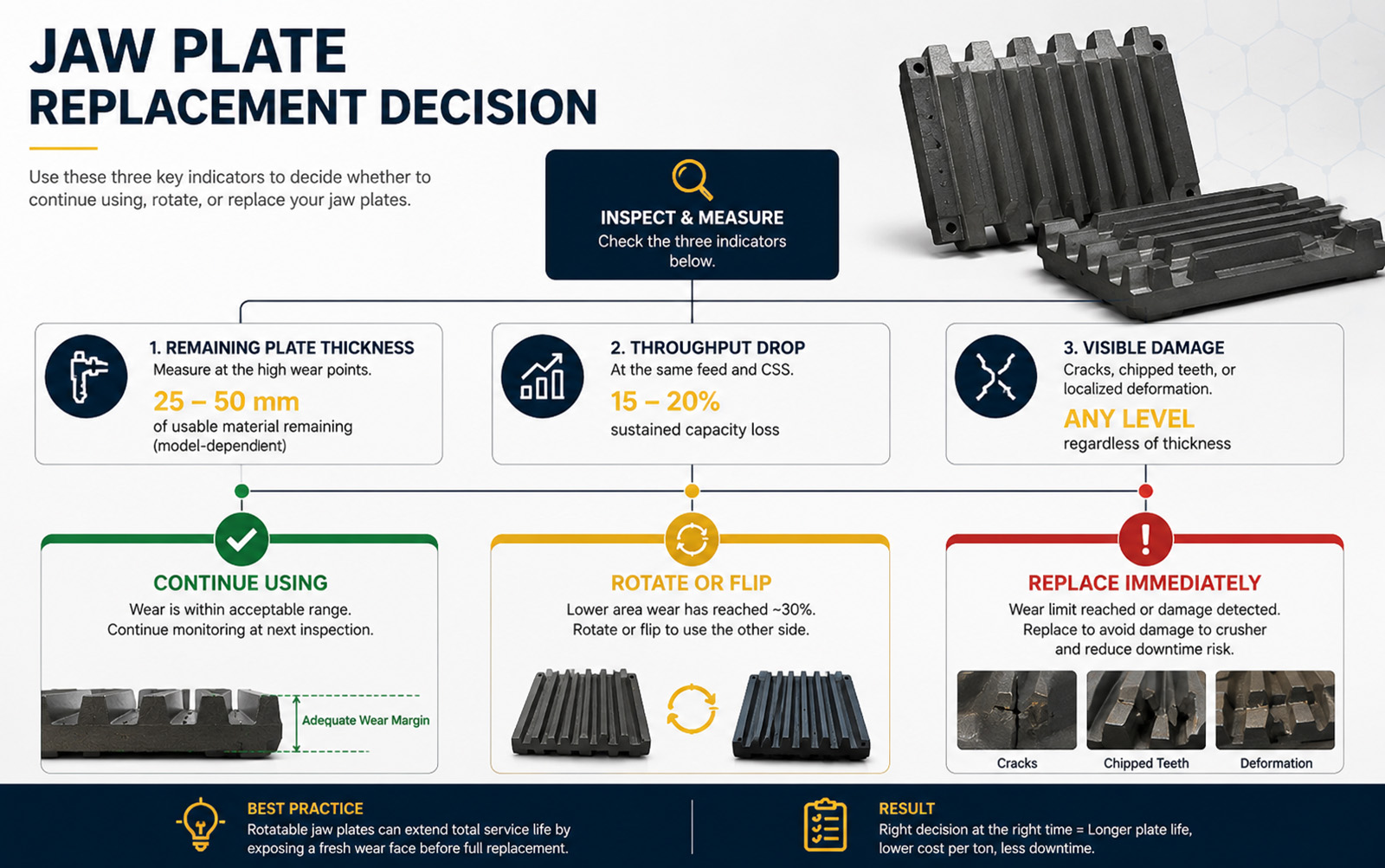
Rather than replacing jaw plates on a fixed calendar, track these three measurable indicators:
| Indicator | Threshold | Action |
|---|---|---|
| Remaining plate thickness | Reduced to roughly 25–50 mm of usable material (model-dependent) | Plan replacement within the next inspection cycle |
| Throughput drop | Sustained capacity loss of 15–20% at the same feed and CSS | Inspect plate profile; schedule replacement if wear is confirmed |
| Visible damage | Cracks, chipped teeth, or localized deformation, regardless of thickness | Replace immediately — do not wait for the next scheduled check |
Under typical operating intensity, jaw plates crushing basalt or similarly hard rock often need replacement every 2.5–3 months, while limestone and other softer feed materials can extend that cycle to 5–6 months. These figures vary with feed size, CSS, and daily operating hours, so they should be treated as planning benchmarks, not fixed rules.
One practical way to extend service life without adding cost: many jaw crushers use plates that can be rotated or flipped to expose a fresh wear face — a technique detailed in Metso's guide on getting the most wear life out of rotatable jaw crusher plates. Using the plate until roughly 30% wear appears in the lower area, then making the first rotation, and running it again until 90–100% of that face is worn before a second rotation, can meaningfully extend total plate life before a full replacement is needed.
Cone Crusher Mantle and Concave Wear: Material Grades
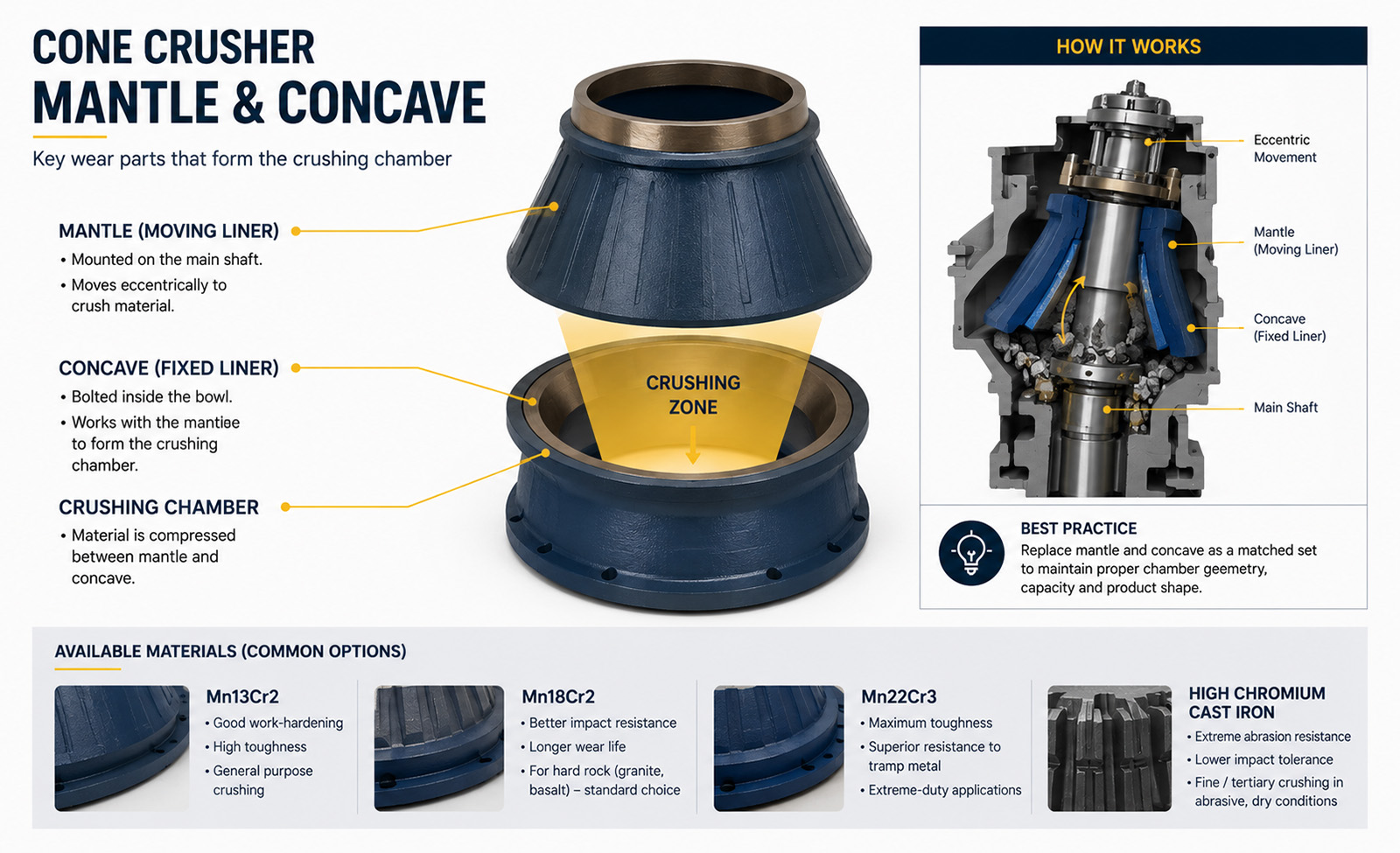
The mantle (moving liner) and concave/bowl liner (fixed liner) in HAMAC's HCS Hydraulic Cone Crusher and HP Hydraulic Cone Crusher use the same manganese-steel family as jaw plates, sometimes paired with high-chromium cast iron for fine-crushing duty.
| Material | Hardness range | Key property | Typical application |
|---|---|---|---|
| ZGMn13 / Mn13Cr2 | 200–240 HB (work-hardens to 450–500 HB) | Strong work-hardening, good toughness | Primary & secondary crushing, general-purpose ore |
| ZGMn18 / Mn18Cr2 | 210–240 HB (work-hardens to 500–550 HB) | Superior impact resistance | Hard rock secondary/tertiary crushing — granite, basalt (industry standard) |
| Mn22Cr3 | 220–250 HB (work-hardens to 550–580 HB) | Maximum toughness, tramp-metal resistance | Coarse chambers, severe shock loading, mining |
| High-chromium cast iron (12–26% Cr) | Up to HRC 60+ | Extreme abrasion resistance, lower impact tolerance | Fine/tertiary crushing in dry, highly abrasive conditions |
Best practice is to always replace the mantle and concave as a matched set — mixing a new liner with a worn counterpart changes the crushing chamber geometry, which reduces both capacity and product consistency, as explained in this technical guide on changing cone crusher liners.
Cone Crusher Liner Replacement Cycle: Reading the Warning Signs
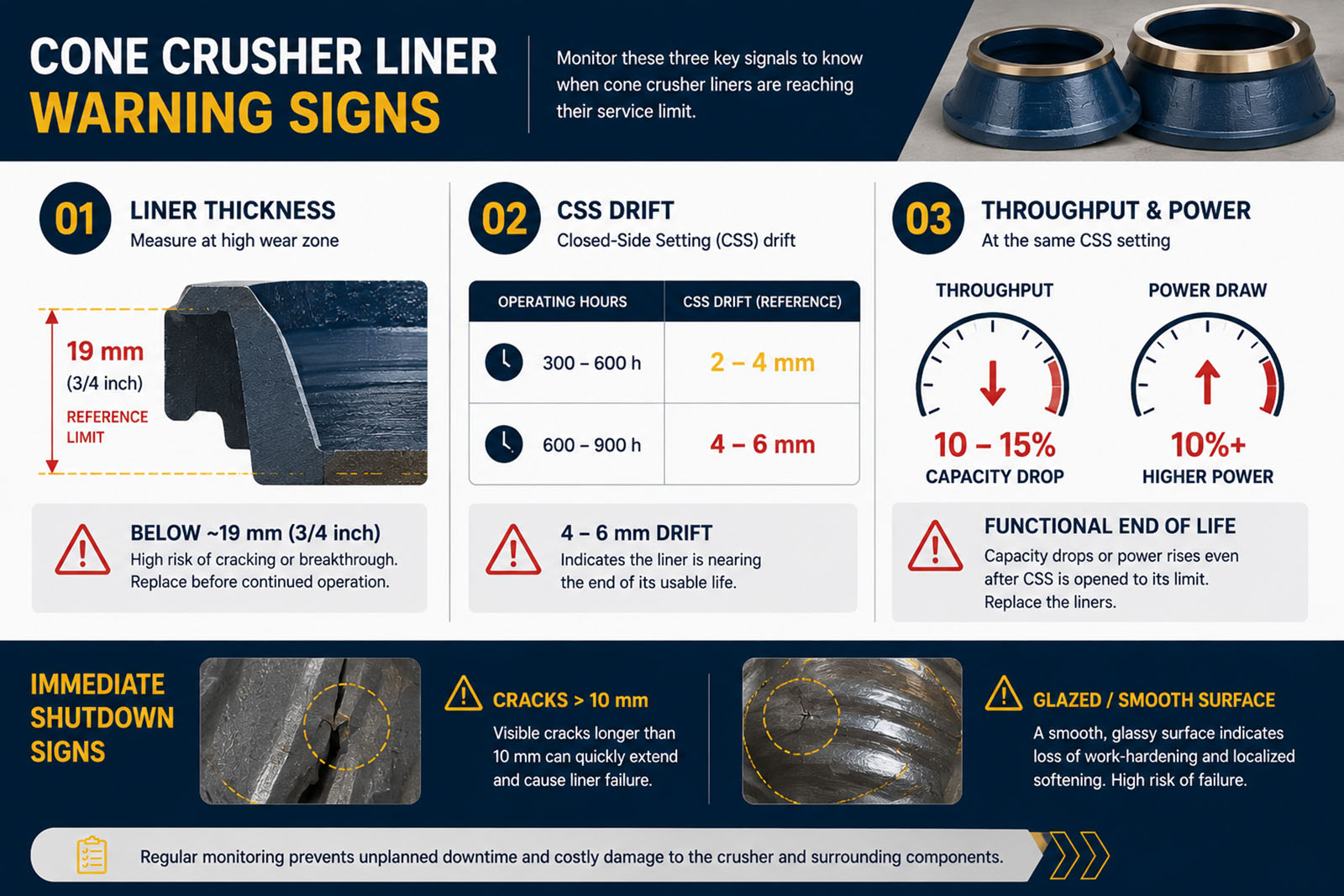
Cone crusher liners rarely fail without warning. These are the three measurable signals that indicate a liner is approaching or past its service limit:
| Signal | Threshold / observation | Interpretation |
|---|---|---|
| Remaining liner thickness | Below roughly 19 mm (¾ inch) in the high-wear zone | High risk of cracking or breakthrough — replace before continued operation |
| Closed-side setting (CSS) drift | 2–4 mm drift after 300–600 hours; 4–6 mm drift after 600–900 hours | 4–6 mm drift signals the liner is nearing the end of its usable life |
| Throughput and power draw | 10–15% capacity drop, or 10% higher power draw for the same output, even after CSS is opened to its limit | The liner has reached "functional end of life" regardless of remaining thickness |
Two additional signs call for immediate shutdown rather than scheduled replacement: visible cracks longer than 10 mm, and a smooth, glassy ("glazed") wear surface that indicates localized loss of hardness — both are early indicators of imminent liner failure, as outlined in this overview of critical signs it's time to replace cone crusher liners.
Wear-Rate Benchmarks by Material Type
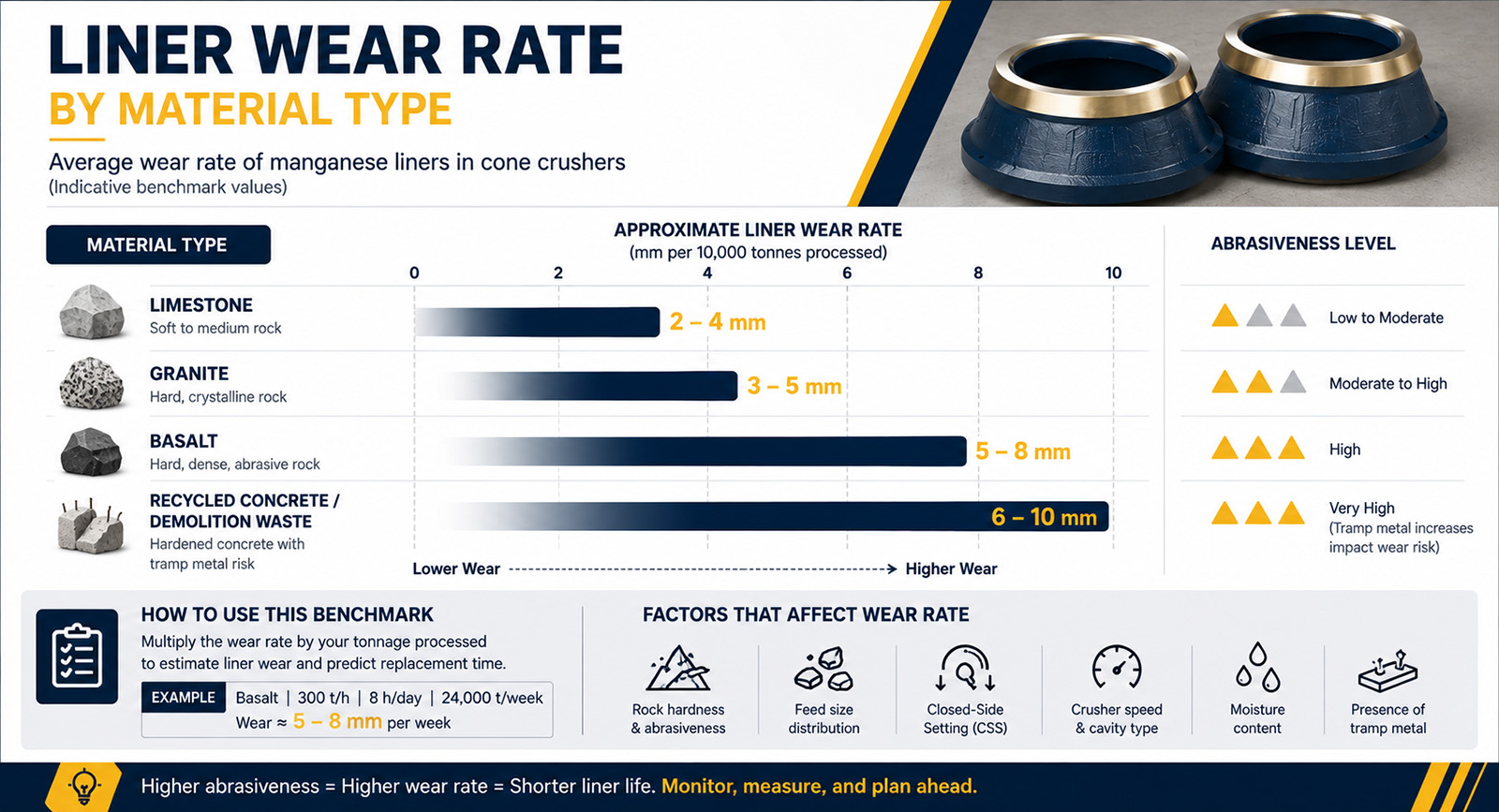
Because abrasiveness varies significantly by rock type, wear-rate benchmarks (expressed per 10,000 tonnes processed) provide a more reliable planning tool than a fixed number of operating hours.
| Material | Approximate liner wear rate | Relative abrasiveness |
|---|---|---|
| Limestone | 2–4 mm per 10,000 t | Low to moderate |
| Granite | 3–5 mm per 10,000 t | Moderate to high |
| Basalt | 5–8 mm per 10,000 t | High |
| Recycled concrete / demolition waste | 6–10 mm per 10,000 t | High, with added risk from embedded rebar and tramp metal |
Using this table, a plant processing 300 t/h of basalt for 8 hours a day accumulates roughly 24,000 tonnes per week — at 5–8 mm of wear per 10,000 t, that translates to an estimated 12–19 mm of liner wear every week, giving maintenance teams a concrete number to plan around instead of waiting for a capacity drop to appear. For a broader view of how material hardness shapes overall equipment selection, see our guide on primary vs secondary vs tertiary crushing equipment selection.
Calculating Your Own Wear Rate and Remaining Life
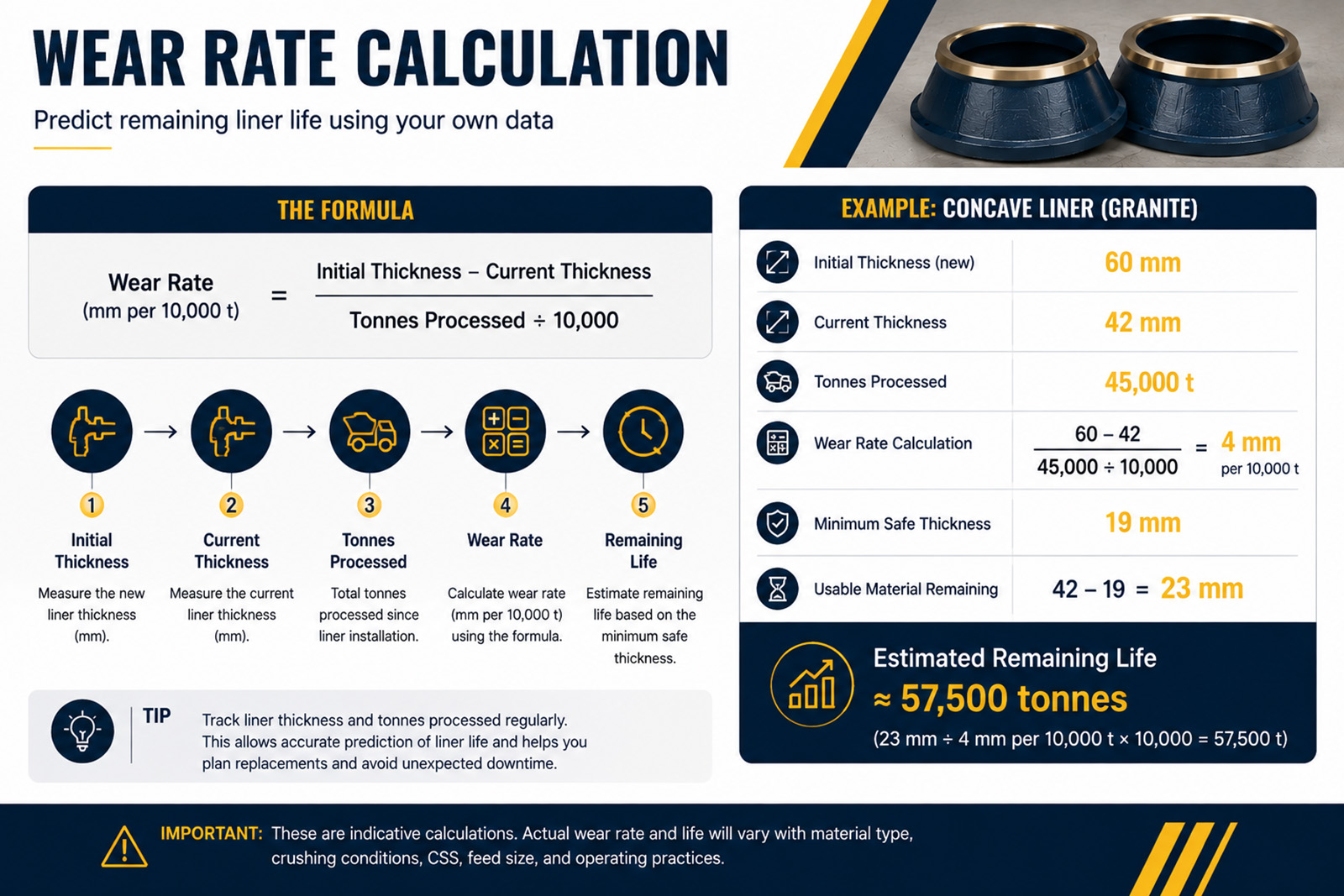
You can build a simple predictive model using your own inspection data:
Wear rate (mm per 10,000 t) = (Initial thickness − Current thickness) ÷ (Tonnes processed ÷ 10,000)
For example, if a concave started at 60 mm, has worn to 42 mm after processing 45,000 tonnes of granite, the wear rate is (60 − 42) ÷ 4.5 = 4 mm per 10,000 t. If the minimum safe thickness for that liner is 19 mm, you have roughly 23 mm of usable material left, or about 57,500 more tonnes before replacement is due — information that can be plugged directly into a production and procurement schedule.
Maintenance Practices That Extend Wear Part Life
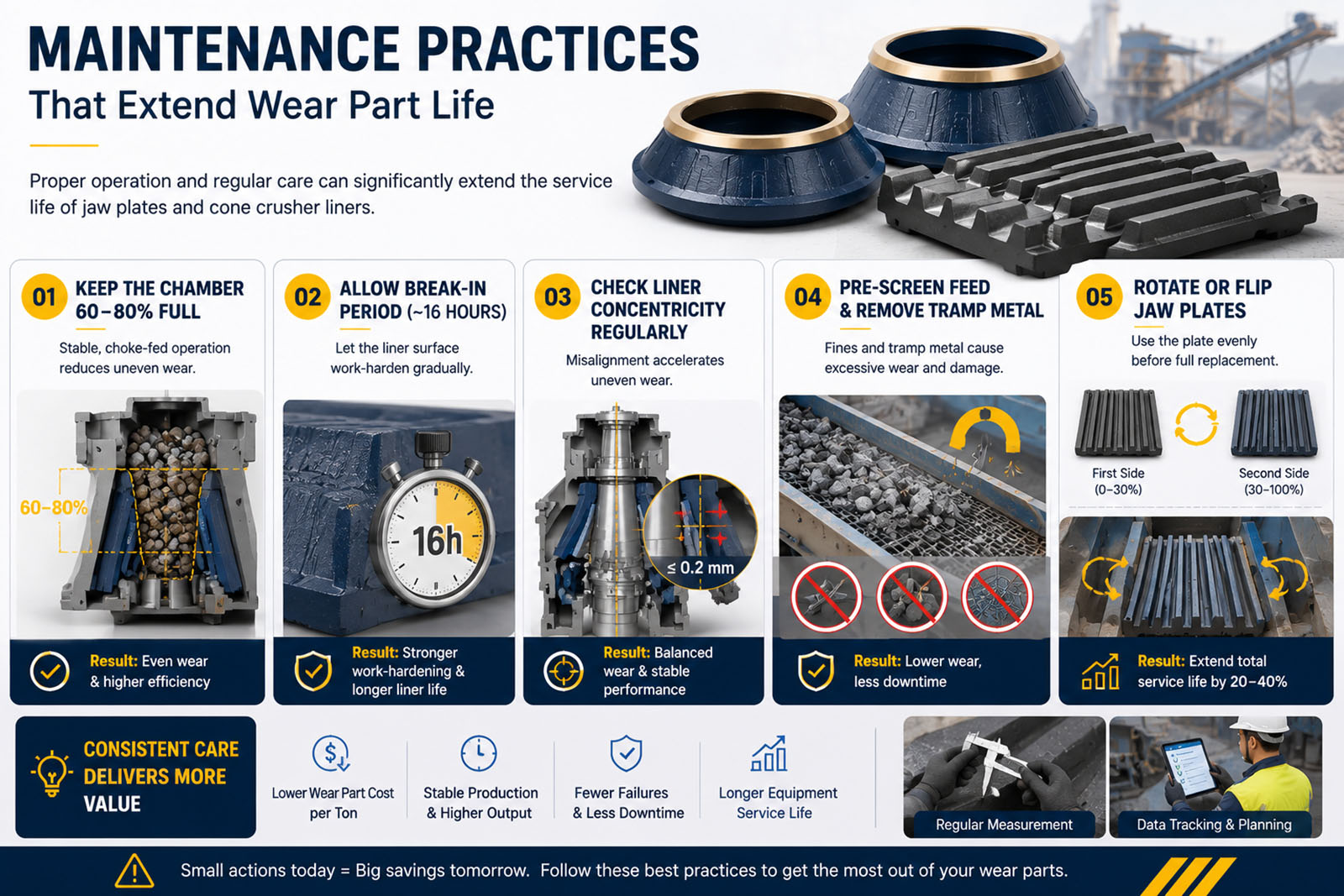
| Practice | Why it matters |
|---|---|
| Keep the crushing chamber 60–80% full during operation | Choke-fed operation distributes load evenly and reduces localized wear compared to running with a starved feed |
| Allow a break-in period of roughly 16 hours for new liners | Lets the manganese surface work-harden gradually under lighter load before full production duty |
| Check liner concentricity regularly | Misalignment beyond about 0.2 mm accelerates uneven wear and can shorten liner life significantly |
| Pre-screen feed to remove fines and tramp metal | Reduces unnecessary wear cycles and lowers the risk of sudden liner damage from foreign material |
| Rotate or flip jaw plates at the recommended wear stage | Extends total plate life by exposing a fresh wear face before full replacement is needed |
Building a Standard Inspection Schedule
| Frequency | Task |
|---|---|
| Weekly | Measure jaw plate and liner thickness at high-wear points; log against tonnage processed |
| Every 300–600 operating hours | Check CSS drift on cone crushers and compare against the 2–4 mm / 4–6 mm benchmark table above |
| Monthly | Visual inspection for cracks, glazing, or uneven wear patterns; check liner concentricity |
| Quarterly or at scheduled wear milestones | Rotate jaw plates if applicable; plan mantle/concave replacement based on calculated remaining life |
Making the Replace-or-Wait Decision
Rather than replacing a wear part purely because "it still has some steel left" or waiting until it fails, compare two numbers: the combined cost of lost production and over-crushed or off-spec product caused by a worn liner, against the cost of a new wear part plus planned downtime for replacement. Once the first number exceeds the second, replacement is the economically correct choice — even if the part is not yet at its absolute physical wear limit.
Data to Prepare Before Ordering Replacement Wear Parts
To get the right manganese grade and replacement plan rather than a generic wear-parts quote, prepare the following information:
| Data to prepare | Why it matters |
|---|---|
| Material type and approximate abrasiveness (granite, basalt, limestone, recycled concrete, etc.) | Determines the appropriate manganese grade (Mn13Cr2, Mn18Cr2, Mn22Cr2) or high-chromium alternative |
| Crusher model and current jaw plate / liner specifications | Ensures correct fit and mounting system (bolt-on vs. wedge-style) |
| Current wear part thickness and estimated tonnage processed since last replacement | Allows calculation of wear rate and remaining service life |
| Observed symptoms (capacity drop, CSS drift, cracking, glazing) | Helps distinguish a routine replacement from an urgent one |
| Daily operating hours and target tonnage | Supports planning of replacement timing around production schedules |
With this information, HAMAC's engineering and spare parts team can recommend the correct manganese grade, estimate expected service life for your specific material, and help schedule replacement to avoid both premature part swaps and unplanned downtime.
Frequently Asked Questions About Jaw Plate and Cone Crusher Liner Wear
How do I know if my jaw plate needs replacing?
Check remaining thickness against the manufacturer's minimum (often in the 25–50 mm range), watch for a sustained 15–20% drop in throughput, and replace immediately regardless of thickness if you see cracks or chipped teeth.
What is the difference between Mn13Cr2, Mn18Cr2 and Mn22Cr2 jaw plates?
They differ mainly in manganese content and resulting wear life: Mn13Cr2 is the cost-effective baseline for softer material, Mn18Cr2 offers 30–40% longer wear life for hard rock like granite and basalt, and Mn22Cr2 provides maximum wear resistance for extreme-duty, highly abrasive applications.
How often should cone crusher liners be replaced?
There is no fixed schedule — replacement should be based on remaining thickness (below ~19 mm in the high-wear zone), CSS drift (4–6 mm signals end-of-life), and throughput loss, rather than a calendar date.
Can I mix a new mantle with an old concave?
It is not recommended. Mixing new and worn liners changes the crushing chamber geometry, which can reduce both capacity and product size consistency — mantles and concaves should be replaced as a matched set.
Does choosing a higher manganese grade always save money in the long run?
Not necessarily. Higher grades like Mn22Cr2 only deliver their wear-life advantage when the material is abrasive enough to fully activate work-hardening; on softer material, the extra cost may not translate into a proportional lifespan gain.
Managing jaw plate and cone crusher liner wear is ultimately a data problem, not a guessing game. Tracking thickness, CSS drift and throughput against the benchmarks above lets you replace wear parts at the point that minimizes total cost — avoiding both wasted steel from early replacement and the far larger repair bills that come from waiting too long. Explore HAMAC's full jaw crusher and cone crusher ranges, or visit the HAMAC homepage to request a wear-parts consultation.