



Jaw Plate Material Selection Guide: Mn13 vs Mn18 vs Mn22 vs High Chromium Cast Iron | HAMAC
Your supplier just sent you a quote with Mn18 and Mn22 jaw plates, a 30% price gap between them — and didn't mention that a fourth material, high chromium cast iron, might actually suit your application better. This guide gives you a straight, data-backed answer using real manganese and chromium content data, the work-hardening mechanism behind these materials, expected service life in hours, and the selection mistakes that quietly cost buyers money.
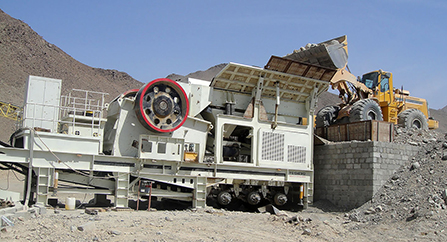
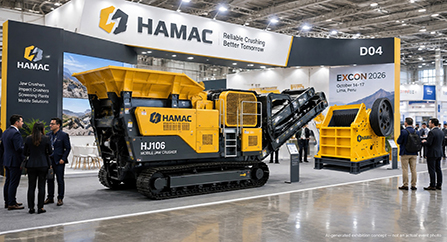
The examples below reference HAMAC's PE Series jaw crusher and European Tech. jaw crusher, whose jaw plate lengths range from 1,100 mm on compact models up to 2,500 mm on the largest 6CX160 unit, meaning plate wear economics can look very different depending on machine size.
The Answer First: A Four-Way Decision Table
Before getting into the "why," here's the comparison most buyers actually want to see first — including the option most articles leave out.
| Material | Manganese content | Chromium content | Hardness | Typical service life | Best for |
|---|---|---|---|---|---|
| Mn13 / Mn14 | 12–14% | 0–1% | 350–440 BHN (work-hardened) | 500–1,000 hours | Limestone, recycled asphalt, soft to medium rock |
| Mn18 | 17–19% | 1.5–2.5% | 400–550 BHN (work-hardened) | 800–1,500 hours | Granite, basalt — the industry-standard choice |
| Mn22 | 21–23% | 1.5–2.5% | 450–600+ BHN (work-hardened) | 1,000–2,000+ hours | Highly abrasive ore, continuous heavy-duty operations |
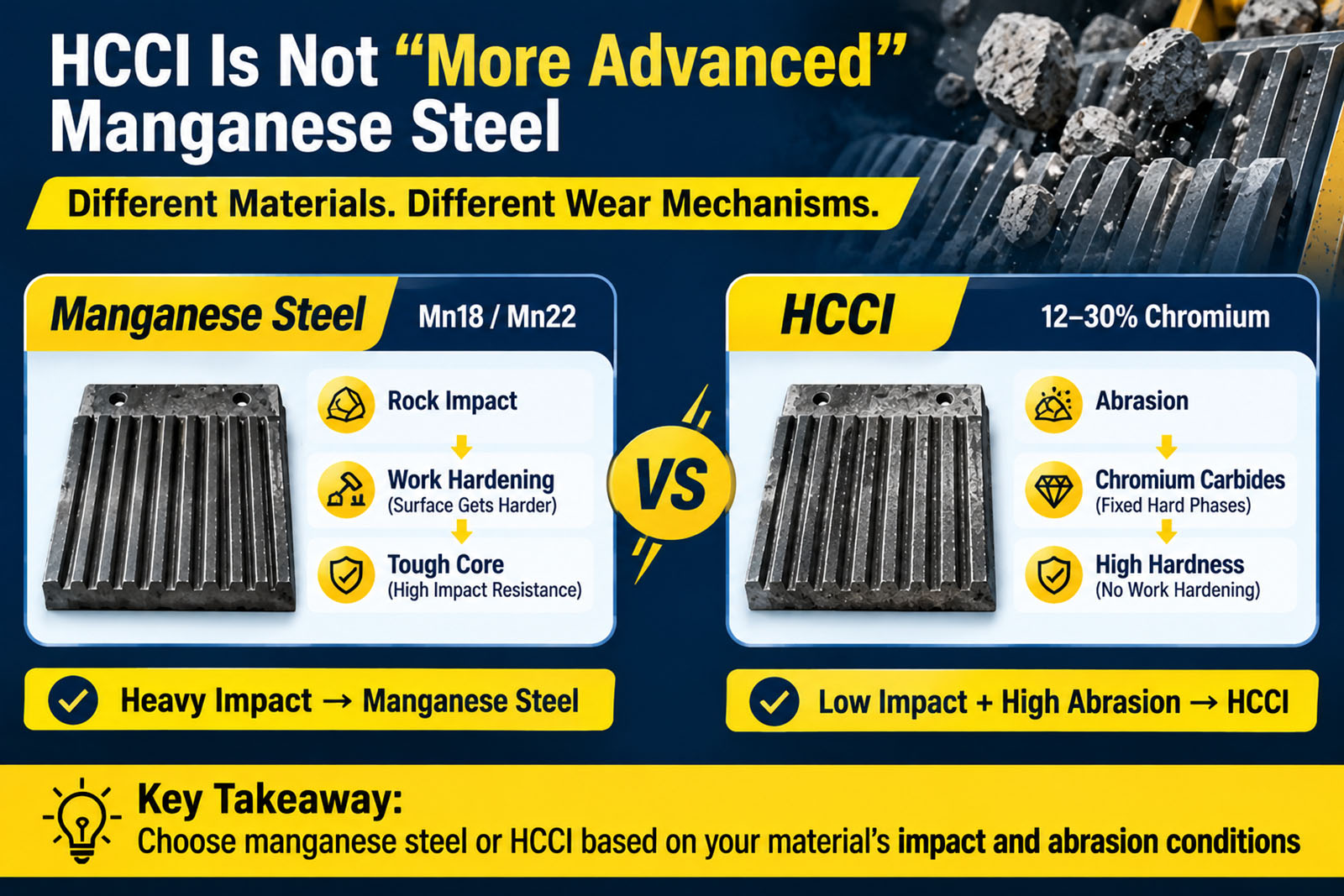
| High chromium cast iron (HCCI) | 0–1% | 12–30% | Up to HRC 60+ (fixed, no work-hardening) | Varies widely; excels in low-impact, high-abrasion duty | Fine crushing, sandy/gritty feed, low-impact abrasive wear |
If you only remember one thing: Mn18 is the safe default for most granite and basalt primary crushing, Mn22 only pays off under continuous choke-fed operation, and HCCI belongs in a different conversation entirely — it's not "better manganese," it's a different wear mechanism suited to different conditions. Read on before assuming your case fits the default.
Why High-Manganese Steel Gets Tougher the Harder You Hit It
Here's the mechanism behind every number in the table above: high-manganese (Hadfield) steel doesn't start out especially hard — fresh out of the mold it sits around 200–220 BHN. What makes it valuable is work hardening: every impact reshapes the surface crystal structure, packing it denser and pushing hardness up toward 400–600 BHN, while the core stays tough and crack-resistant. This is well documented in academic wear studies on Hadfield steel liners used in rock crushing machinery.
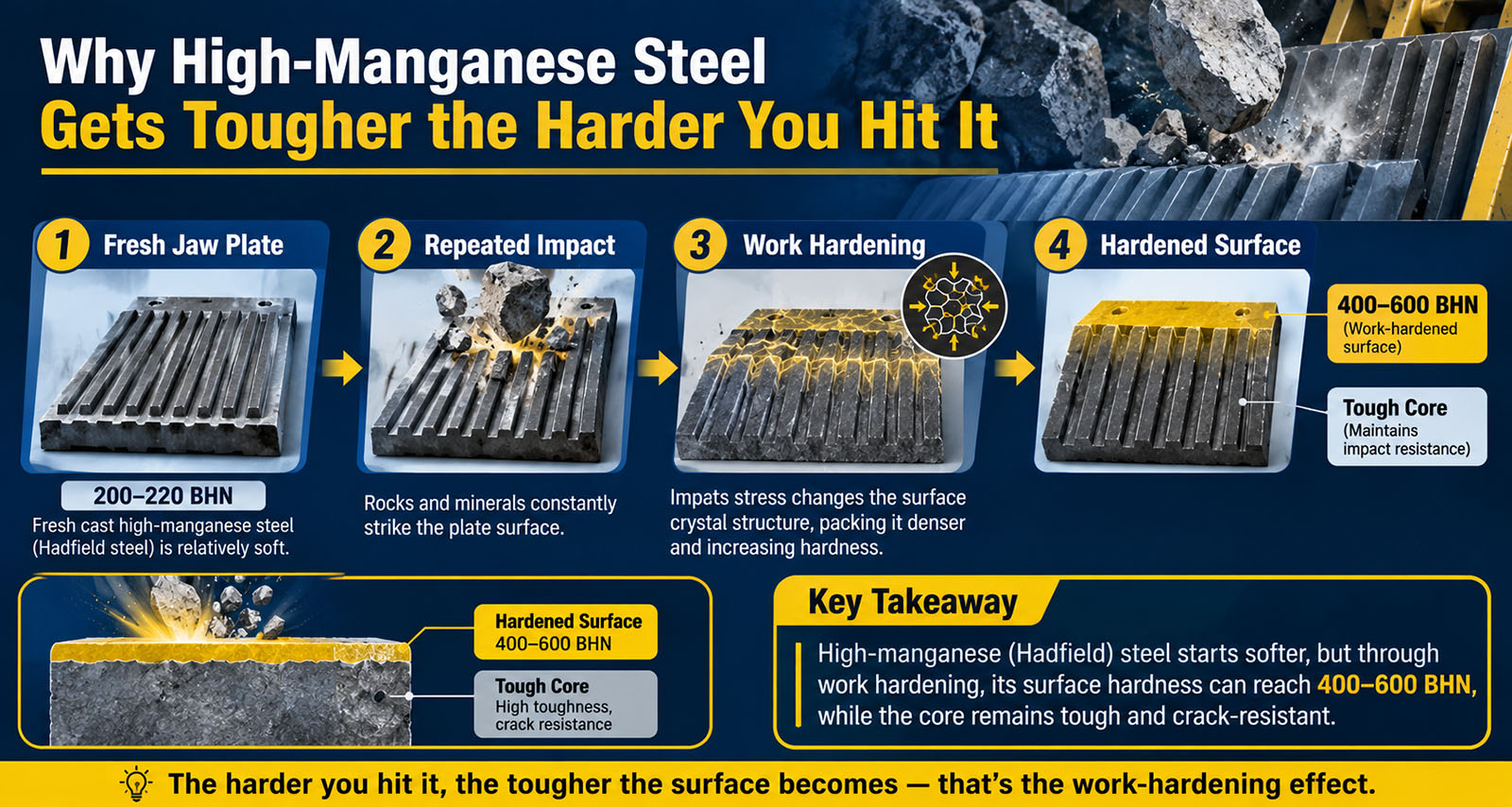
The practical implication: a jaw plate only performs to its rated hardness if it's actually being hit hard and often enough to trigger this effect. That's the single biggest factor behind whether Mn18 or Mn22 is the right call — not just the rock type, but how continuously the crusher runs.
Why Mn18 Became the Industry Standard
Mn18's 17–19% manganese content sits at the sweet spot where the work-hardening effect described above is strong enough to handle granite and basalt, without the brittleness risk that comes with pushing manganese content even higher. Upgrading from Mn13 to Mn18 typically extends service life by 30–50% for the same hard-rock application — usually enough to justify the price difference on its own.
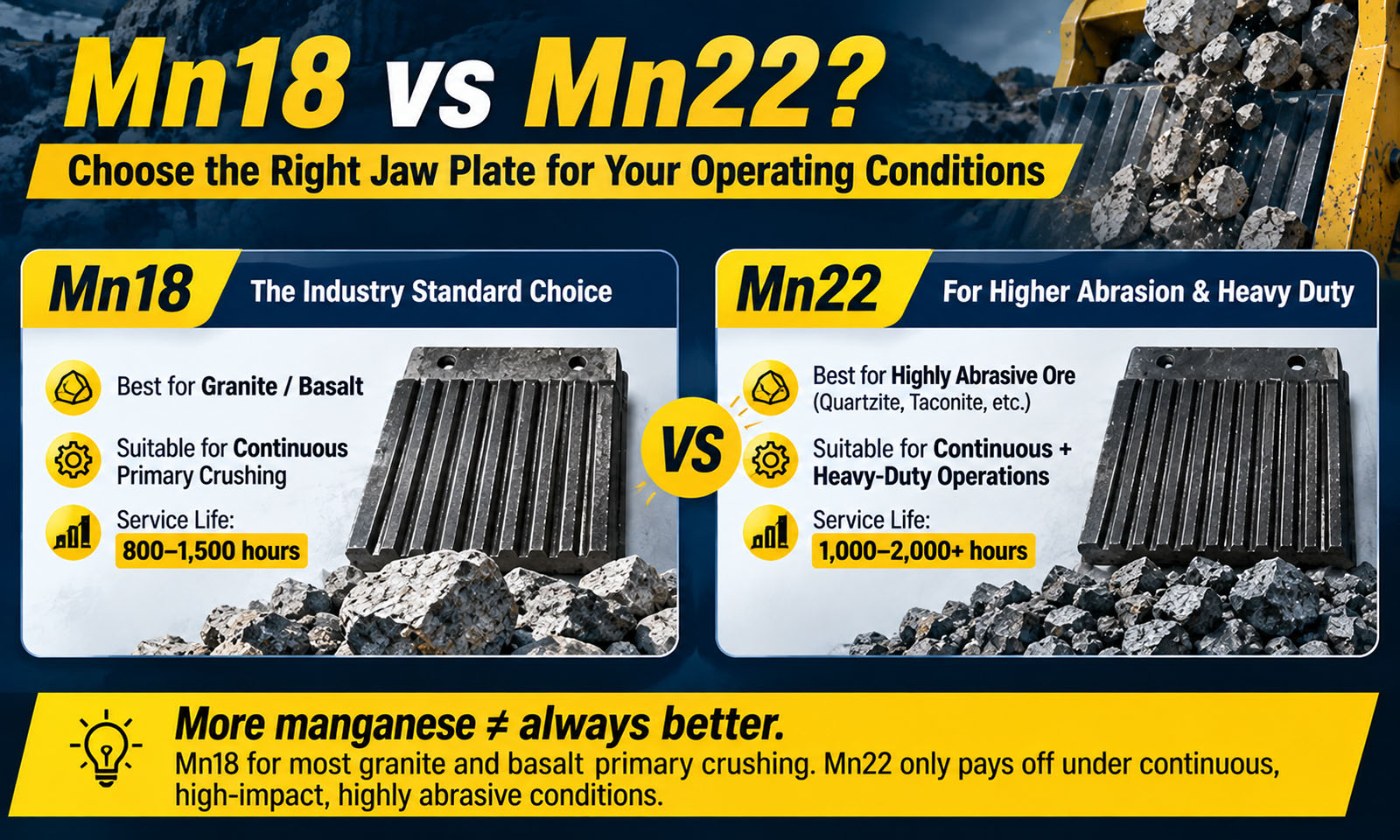
Mn22's higher manganese content makes it more brittle than Mn18. If your jaw crusher isn't running choke-fed (chamber kept consistently full), it may never generate enough sustained impact energy to activate the extra work-hardening you're paying for — meaning a more expensive, more brittle plate with no real lifespan benefit. Mn22 earns its price premium specifically in continuous, high-tonnage operations crushing quartzite, taconite, or other highly abrasive ore.
The Fourth Option: When You Should Skip Manganese Steel Entirely
All three manganese grades above rely on impact to perform. But if your wear problem isn't impact — it's fine, gritty, high-silica material grinding against the plate at lower impact energy — manganese steel may never work-harden enough to compete with high chromium cast iron (HCCI). HCCI contains 12–30% chromium and derives its hardness (often HRC 60+) directly from hard chromium-carbide particles in the microstructure, not from impact-driven hardening, a distinction explained in this wear liner materials selection guide.
The trade-off: HCCI is significantly more brittle than manganese steel and performs poorly under heavy shock loading — it's a poor fit for primary jaw crushing of large, irregular blocks, but can outperform manganese steel in fine-crushing stages or applications with high silica/sand content and lower impact energy.
Chromium Content in Manganese Steel: Don't Confuse It With HCCI
It's worth being precise here, because "chromium" shows up in two very different contexts in this article. In Mn18/Mn22 jaw plates, chromium is a minor alloying addition (1.5–2.5%) that fine-tunes abrasion resistance without taking over the material's behavior. In HCCI, chromium is the dominant element (12–30%) that defines the entire wear mechanism. These are not "more of the same" — they're different materials solving different wear problems.
| Chromium level (within manganese steel) | Effect |
|---|---|
| Below 1.5% | Lower resistance to fine abrasive wear; plate rounds off faster on gritty material |
| 1.5–2.5% (typical range) | Balanced: improved abrasion resistance without compromising the manganese work-hardening effect |
| Above 2.5% | Diminishing returns — can suppress work-hardening and increase brittleness under heavy impact |
The takeaway: don't assume "higher chromium = better" within a manganese steel plate. A plate advertised with unusually high chromium content isn't automatically superior — it may underperform a properly balanced Mn18 or Mn22 plate in real impact conditions.
Matching Material to Your Rock Type and Machine
Using the technical data from HAMAC's jaw crusher range as a reference point, here's how material selection typically maps to application and machine size:
| Material / application | Recommended grade | Example HAMAC model | Feed opening |
|---|---|---|---|
| Limestone, gypsum, dolomite (soft rock) | Mn13/Mn14 | PE600×900 | 600×900 mm |
| Granite, basalt (standard hard rock) | Mn18 | PE900×1200 | 900×1200 mm |
| Iron ore, copper ore, manganese ore (continuous high tonnage) | Mn18 or Mn22 depending on duty cycle | 6CX140 European Tech. jaw crusher | 1400×1070 mm |
| Quartzite, taconite (extreme impact abrasion) | Mn22 | 6CX160 European Tech. jaw crusher | 1600×1200 mm |
| Fine crushing, sandy/high-silica feed (secondary/tertiary stage) | High chromium cast iron (HCCI) | Typically paired with secondary cone crusher or impact crusher liners | — |
Three Selection Mistakes That Quietly Waste Budget
| Mistake | Why it costs you |
|---|---|
| Defaulting to Mn18 for every job "just to be safe" | Overspending on soft rock that would perform fine on cheaper Mn13, or underperforming on extreme-duty ore that really needs Mn22 |
| Assuming higher chromium content always means a better plate | Chromium above ~2.5% in a manganese plate can suppress work-hardening and increase brittleness, actually shortening service life under heavy impact |
| Comparing jaw plate quotes by unit price instead of cost per operating hour | A plate priced 20% below OEM but wearing out 40–50% faster ends up costing more once labor and downtime for extra changeouts are factored in |
Maintenance Note
Once you've chosen the right material, how you monitor wear and time your replacements matters just as much for total cost. For thickness thresholds, flip-timing schedules, and a full inspection checklist, see our companion guide: Jaw Plate and Cone Crusher Liner Wear: Replacement Cycle and Maintenance Guide.
Frequently Asked Questions
Is Mn18 or Mn22 better for granite?
Mn18 is the standard choice for most granite operations and offers the best balance of cost and wear life. Mn22 only makes sense if your crusher runs continuous, choke-fed shifts at high tonnage.
Does higher chromium content always mean a better jaw plate?
No. Within manganese steel, chromium content above roughly 2.5% can suppress the work-hardening effect and increase brittleness, so a "high-chromium" manganese plate isn't automatically superior to a properly balanced Mn18 or Mn22 grade.
Is high chromium cast iron better than manganese steel for jaw plates?
Not for primary jaw crushing of large rock — HCCI is too brittle for heavy shock loading. It performs better in lower-impact, high-abrasion applications such as fine crushing or sandy/high-silica feed, typically in secondary or tertiary stages rather than the primary jaw crusher.
Why does my jaw plate wear out faster than expected even though I bought Mn22?
This is often a duty-cycle mismatch — Mn22 needs sustained, choke-fed impact to fully work-harden. If the crusher runs with a starved or inconsistent feed, the plate may never reach its full rated hardness, resulting in wear rates closer to a lower grade.
Choosing between Mn13, Mn18, Mn22 and high chromium cast iron comes down to two questions: how abrasive is your material, and how much sustained impact does your crusher actually deliver? Match the material to both answers, keep chromium content within the 1.5–2.5% range for manganese plates, and avoid the three common mistakes above. Browse HAMAC's full jaw crusher range and genuine spare parts selection, or send us your material type and capacity for a jaw plate grade recommendation matched to your project.