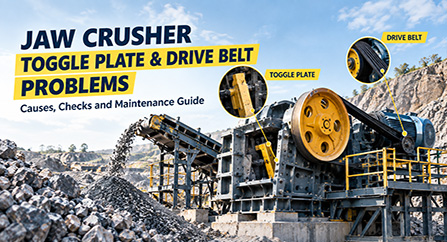






Jaw Crusher Toggle Plate and Drive Belt Problems: Causes and Maintenance Guide | HAMAC
Is your jaw crusher toggle plate broken, or is the drive belt slipping, squealing or wearing out too quickly? These two parts control how power reaches the crushing chamber, so a fault often causes lost power, reduced output or an unexpected shutdown.
The good news is that most toggle plate and belt problems are easy to identify. This guide explains what each part does, why it fails and how to check and prevent problems safely.
For other jaw crusher faults, see HAMAC’s Jaw Crusher Troubleshooting Guide.
What Do the Toggle Plate and Drive Belt Do?
| Part | Main Function | Why It Matters |
|---|---|---|
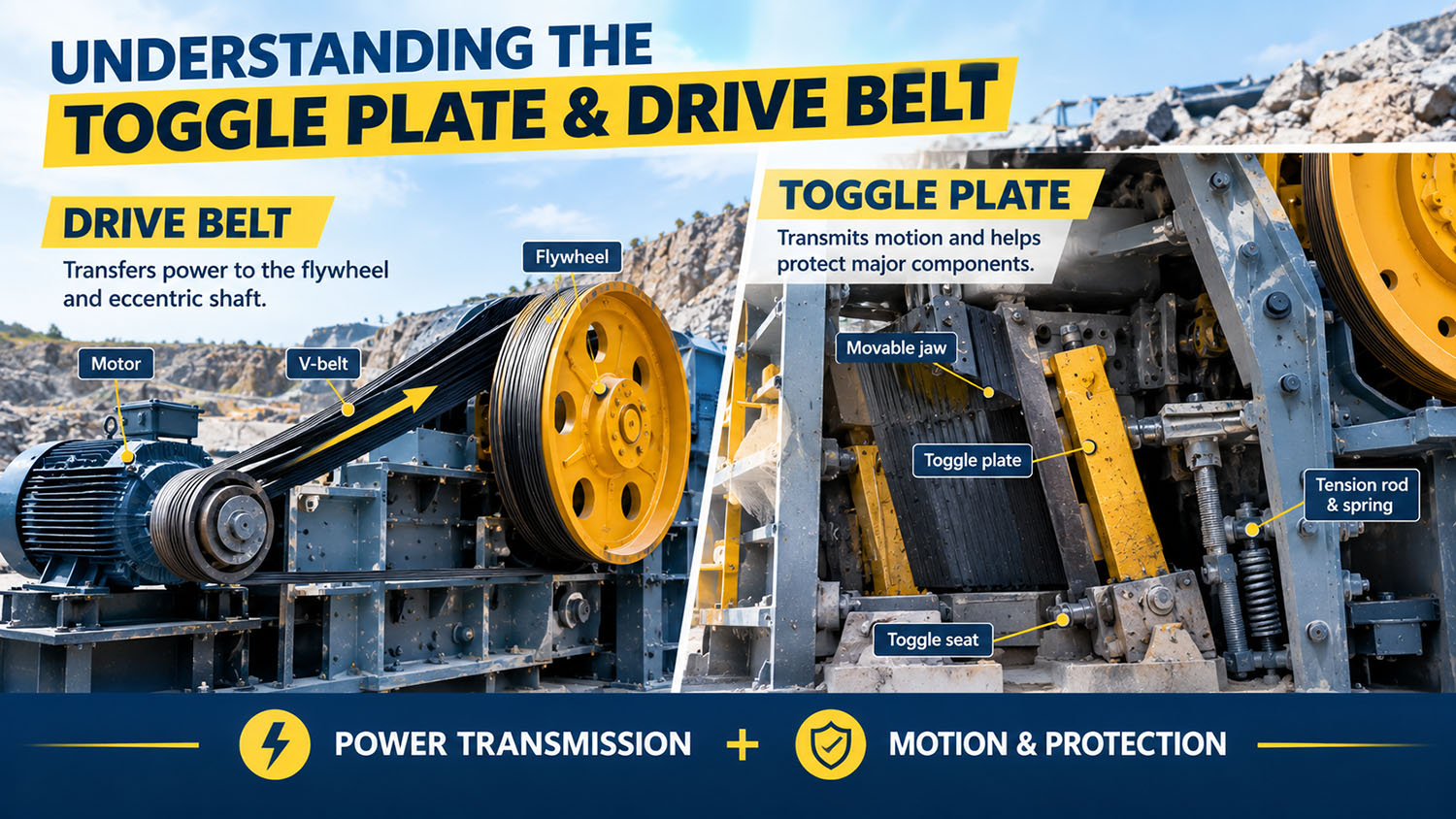
| Drive belt (V-belts) | Transfers power from the motor to the flywheel and eccentric shaft | If the belt slips, the crusher loses crushing power and output drops. |
| Toggle plate | Transmits motion to the movable jaw and acts as a safety part | It is designed to break when uncrushable material enters, protecting more expensive parts. |
| Toggle seat | Supports the ends of the toggle plate | Worn seats cause knocking, poor contact and toggle damage. |
| Tension rod and spring | Keeps the toggle plate in position | A loose or broken spring causes knocking and unstable movement. |
Important: The toggle plate is often a designed “weak point.” In many jaw crushers it is built to break when a piece of steel or other uncrushable object enters the chamber, which helps protect the frame, bearings and eccentric shaft.
Quick Symptom Guide
| Symptom | Likely Cause | First Check |
|---|---|---|
| Crusher loses power under load | Belt slipping or loose tension | Belt tension, wear and pulley condition |
| Squealing or burning smell from the drive | Belt slip or overload | Belt tension, load and pulley grooves |
| Belt runs to one side | Pulley misalignment | Motor and crusher pulley alignment |
| Belts wear out quickly | Misalignment, wrong tension or worn pulley | Alignment, tension and pulley groove wear |
| Movable jaw stops moving | Broken toggle plate | Toggle plate, tramp metal and chamber |
| Metallic knocking sound | Loose toggle, worn seat or broken tension spring | Toggle plate, seat and tension assembly |
| Toggle plate breaks repeatedly | Tramp metal, overload or wrong part | Feed inspection and toggle specification |
Safety First
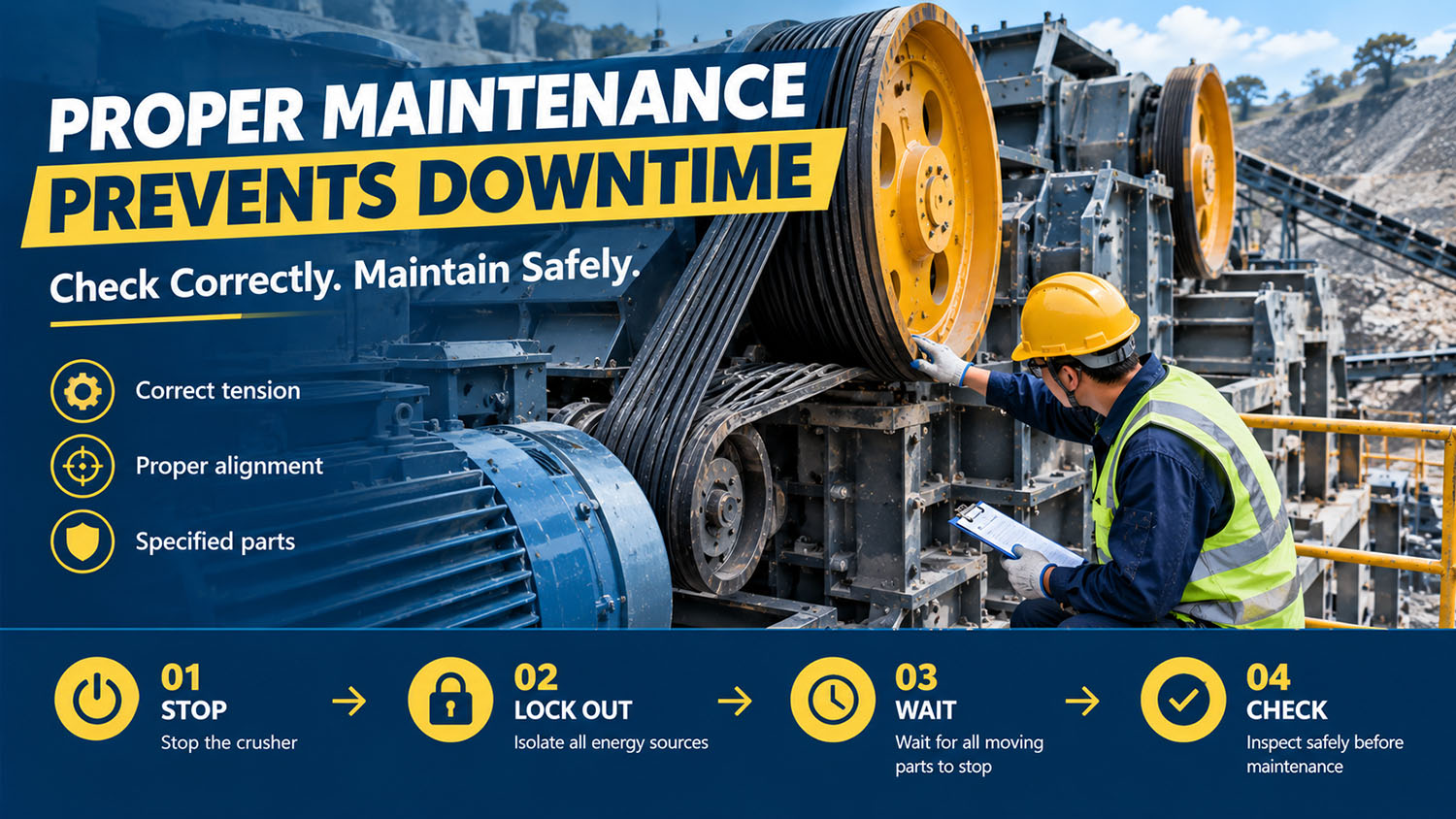
Never inspect, adjust or replace the toggle plate or drive belt while the crusher is energized or capable of movement.
Stop the feeder and shut down the crusher、Isolate and lock out all energy sources、Wait until the flywheel and all moving parts stop completely、Control stored spring energy in the tension assembly before removing parts.
See the OSHA Control of Hazardous Energy Standard for general maintenance-safety requirements.
Drive Belt Problems and Solutions
1. Belt Slipping
Problem: The belt cannot transfer full power, so the crusher loses speed and output under load. Slipping also creates heat, squealing and rapid belt wear.
Check: Inspect belt tension, belt wear, oil or dust on the belt, pulley groove wear and whether the crusher is overloaded.
Solution: Adjust to the correct tension, clean contaminated belts and pulleys, and replace worn belts as a matched set. Do not over-tighten to stop slipping, because excessive tension increases bearing load.
For bearing load and heat problems, see the Jaw Crusher Bearing Overheating Guide.
2. Incorrect Belt Tension
Problem: A belt that is too loose slips and slaps. A belt that is too tight increases the load on the shaft and bearings and shortens their life.
Check: Compare the belt deflection with the value specified for the belt and crusher model. Look for vibration, heat or unusual belt movement.
Solution: Set the tension to the manufacturer’s recommendation and re-check after a short run-in period, since new belts often stretch during the first hours of operation.
3. Pulley Misalignment
Problem: If the motor and crusher pulleys are not parallel, the belt wears on one side, runs hot and fails early. Misalignment can also cause vibration.
Check: Inspect pulley alignment, motor-base bolts and belt tracking. Look for shiny or worn belt edges.
Solution: Align the pulleys correctly, tighten the motor base and replace damaged belts. For vibration problems, see the Jaw Crusher Vibration and Noise Guide.
4. Worn Belts or Pulleys
Problem: Cracked, glazed or stretched belts and worn pulley grooves reduce grip and power transfer.
Check: Inspect belts for cracks, glazing, fraying and uneven wear. Check pulley grooves for wear and damage.
Solution: Replace belts as a complete matched set, and replace worn pulleys. Do not mix old and new belts, because unequal length causes uneven load.
| Belt Sign | Meaning | Action |
|---|---|---|
| Glazed, shiny surface | Slipping and heat | Check tension and pulley condition |
| Cracks on the underside | Age, heat or fatigue | Replace the belt set |
| Worn edges on one side | Misalignment | Align the pulleys |
| Frayed or stretched belt | Overload or old belt | Replace and check load |
Toggle Plate Problems and Solutions
1. Broken Toggle Plate
Problem: The movable jaw stops moving and crushing stops. In many designs the toggle plate is built to break when uncrushable metal or other foreign objects enter the chamber, protecting the frame, bearings and shaft.
Check: After isolation, inspect the toggle plate, toggle seats, chamber and feed for tramp metal or foreign objects.
Solution: Remove the foreign object, replace the toggle plate with the correct part and improve feed inspection to prevent uncrushable material entering the crusher.
Do not replace a broken toggle plate with a stronger, non-standard part. This can remove the built-in overload protection and allow more expensive damage.
2. Toggle Plate Keeps Breaking
Problem: Repeated toggle failure usually points to a recurring cause, not a weak part.
| Possible Cause | What to Check |
|---|---|
| Tramp metal in the feed | Loader practice, feed source and metal detection |
| Overloading the crusher | Feed rate, oversized rock and motor load |
| Wrong toggle plate specification | Part number for the specific crusher model |
| Worn toggle seats | Contact surfaces and seat condition |
| Incorrect installation | Fit, position and tension assembly |
Solution: Correct the root cause, use the specified toggle plate and inspect the feed. For blockage and tramp-metal issues, see the Jaw Crusher Blockage and Choking Guide.
3. Worn Toggle Seat or Loose Tension
Problem: Worn toggle seats, a loose tension rod or a broken tension spring cause metallic knocking and unstable jaw movement.
Check: Inspect the toggle seat contact surfaces, tension rod, spring and toggle-plate movement after shutdown.
Solution: Replace worn seats and springs, and set the tension assembly correctly so the toggle plate stays properly seated during operation.
How to Prevent Toggle Plate and Belt Problems
| Prevention Area | Practical Action |
|---|---|
| Feed control | Keep tramp metal and oversized material out of the crusher |
| Belt tension | Set and re-check tension, especially after installing new belts |
| Pulley alignment | Keep the motor and crusher pulleys parallel and aligned |
| Belt replacement | Replace belts as a matched set and replace worn pulleys |
| Toggle inspection | Check the toggle plate, seats, tension rod and spring regularly |
| Correct parts | Always use the toggle plate and belts specified for the model |
| Records | Record belt and toggle replacement dates and failure causes |
Include these items in your routine maintenance. For a full schedule, read the Jaw Crusher Maintenance Checklist.
When to Stop the Crusher
| Warning Sign | Action |
|---|---|
| Movable jaw stops moving | Stop and inspect the toggle plate and chamber after isolation. |
| Loud metallic knocking | Stop and inspect the toggle, seat and tension assembly. |
| Burning smell or hot belts | Stop immediately and check belt slip and load. |
| Belt badly damaged or thrown off | Stop and replace the belt set safely. |
| Repeated toggle or belt failure | Stop and find the root cause before continuing. |
Frequently Asked Questions
What is the function of a jaw crusher toggle plate?
The toggle plate transmits motion to the movable jaw and acts as a safety part. In many crushers it is designed to break when uncrushable material enters, protecting the frame, bearings and eccentric shaft.
Why does my jaw crusher toggle plate keep breaking?
Repeated failure is usually caused by tramp metal, overloading, a wrong or non-standard toggle plate, worn toggle seats or incorrect installation. Correct the root cause and use the specified part.
Why is my jaw crusher belt slipping?
Common causes are loose tension, worn belts, contaminated belts, worn pulley grooves or overload. Adjust the tension, clean or replace the belts and check the load.
Should I over-tighten the belt to stop slipping?
No. Excessive tension increases the load on the shaft and bearings and shortens their life. Use the tension specified for the belt and crusher model.
Do I have to replace all the belts together?
Yes. Replace V-belts as a matched set. Mixing old and new belts causes uneven length and uneven load sharing.
Can a broken toggle plate be replaced with a stronger one?
No. Using a stronger, non-standard toggle plate can remove the built-in overload protection and allow more expensive damage. Always use the specified part.
Final Reminder
Keep tramp metal out, keep the belts correctly tensioned and aligned, and always use the specified toggle plate and belts. These simple habits prevent most toggle plate and drive belt problems and reduce unexpected downtime.