



How to Reduce Conveyor Transfer Point Dust and Material Spillage | HAMAC
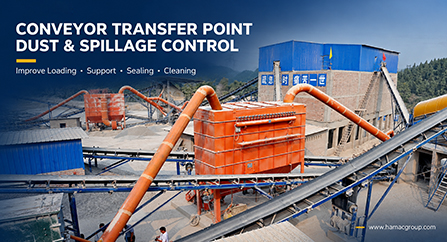
To reduce conveyor transfer point dust and material spillage, first identify where the material escapes. Check loading direction, belt alignment, support under the loading zone and skirt sealing before adding more water or replacing individual components.
Dust leaking from an enclosure, stone spilling beside the receiving belt and residue falling from the return belt are different problems. A practical solution addresses the cause rather than relying on repeated cleanup.
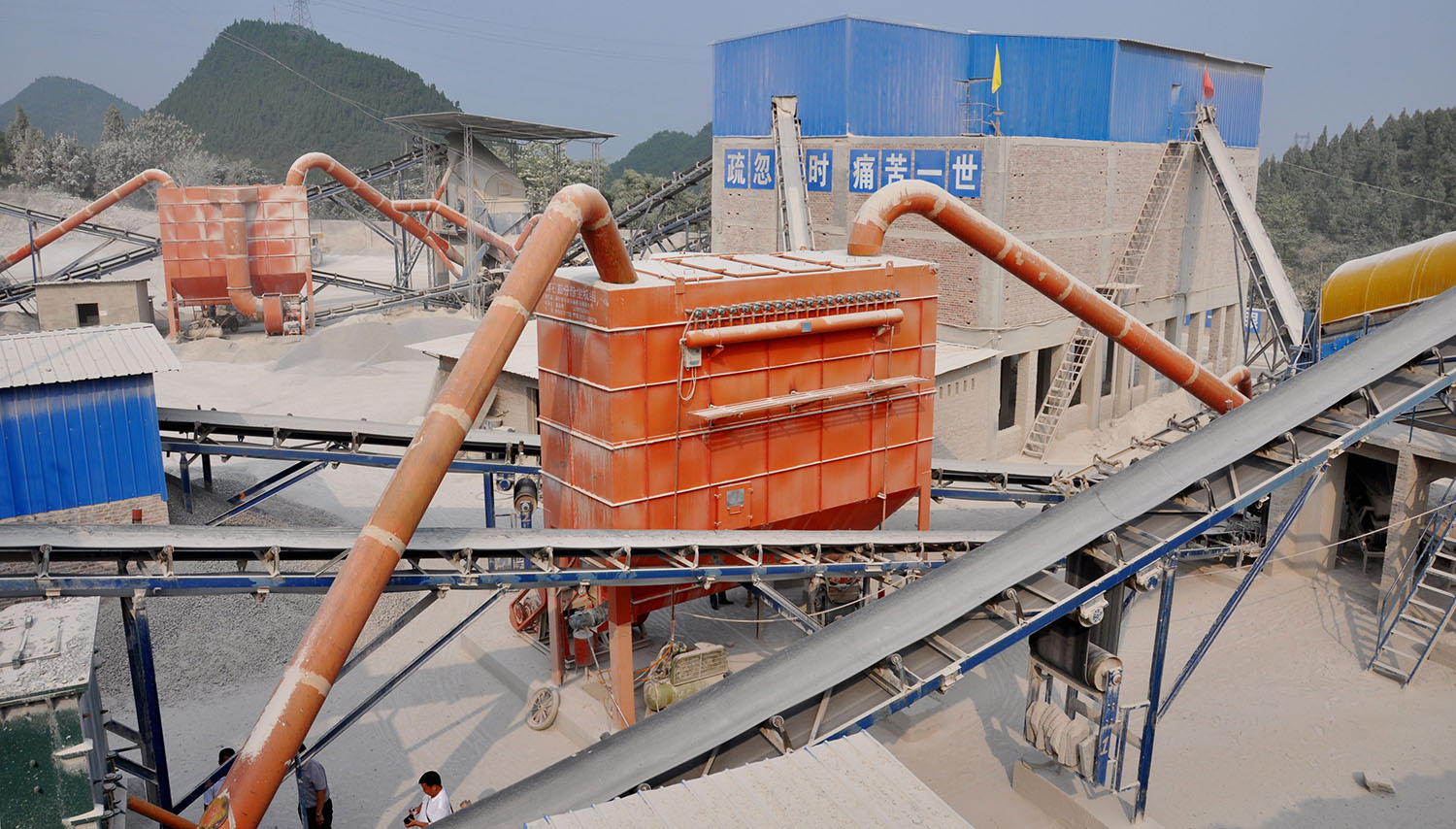
1. Identify Dust, Spillage or Carryback
| Problem | Typical Observation | First Checks |
|---|---|---|
| Loading-zone spillage | Material collects beside the belt near the transfer chute | Off-center loading, peak flow, belt support, tracking, wear liners and skirt seals |
| Airborne dust | Dust escapes through enclosure gaps or at the entrance and exit | Material impact, airflow, containment and the suitability of existing dust controls |
| Carryback | Material remains on the belt after discharge and falls along the return run | Belt cleaning, material adhesion, belt condition and cleaner compatibility |
Do not assume that all material below a conveyor comes from the transfer chute. Carryback requires attention at the discharge and cleaning system, while loading-zone leakage requires attention to receiving-belt conditions and containment.
Flexco's aggregate conveyor guidance discusses carryback, mistracking and dust spillage as related but distinct problems. Read its aggregate belt conveyor troubleshooting overview.
2. Correct Loading, Belt Support and Sealing
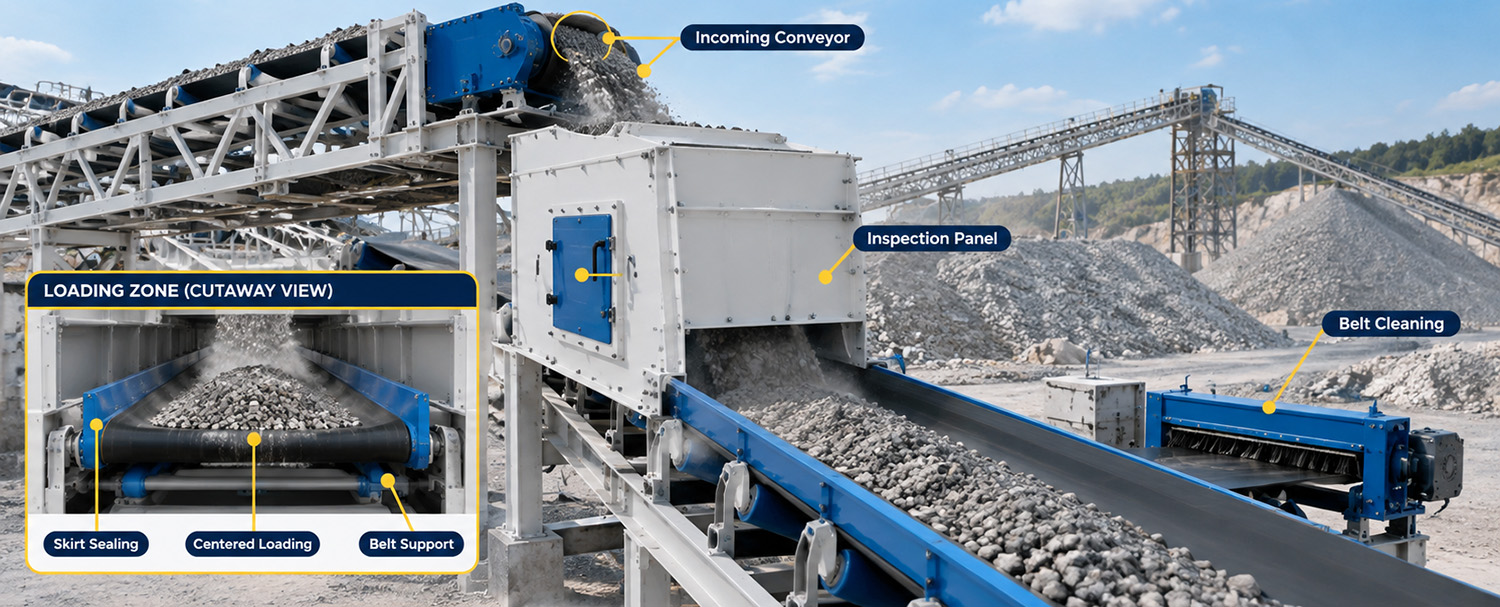
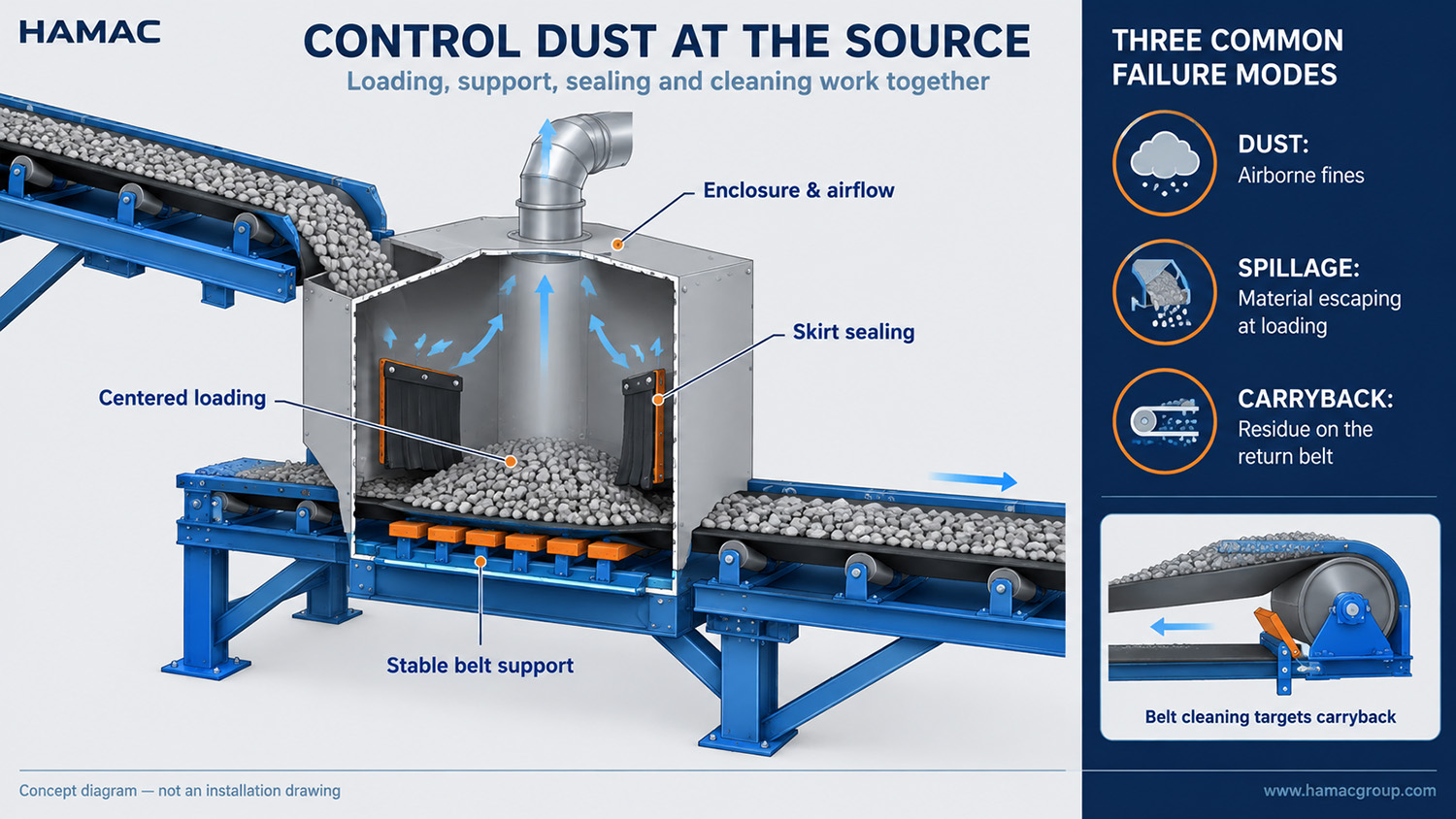
A skirt seal cannot maintain consistent containment if the belt moves away from it, sags between supports or receives an unstable, off-center load. Inspect the complete loading zone rather than treating the sealing strip as an isolated part.
| Symptom | Possible Cause | Corrective Direction to Evaluate |
|---|---|---|
| Spillage mainly on one side | Off-center loading or belt mistracking | Review the material trajectory, chute direction, belt position and condition of relevant components |
| Fine material leaks beneath the skirt | Belt sag, worn seals, unsuitable adjustment or insufficient support | Stabilize the belt path and review the wear liner and sealing arrangement |
| Heavy impact and material bouncing | Uncontrolled fall or unsuitable receiving arrangement | Review drop height, material direction, impact support and chute geometry |
| Overflow during feed surges | Peak loading exceeds a chute, belt or downstream restriction | Check peak flow, loading cross-section, belt speed and downstream capacity |
| Dust blows from enclosure openings | Turbulent air, leakage paths or insufficient containment | Review enclosure geometry, airflow, settling space and any extraction requirement |
Prioritize a stable belt path, controlled loading and appropriate containment. Where possible, guide material onto the receiving belt in a controlled direction and avoid unnecessary impact or abrupt changes in flow.
Wear liners and flexible seals have different duties. The liner arrangement should manage the bulk material, while the seal helps contain escaping fines and dust. Do not compensate for poor support or misalignment by applying excessive seal pressure against the belt.
Martin Engineering explains that belt sag creates gaps through which air and fines can escape, even when sealing components are installed. Its guidance also links chute design, impact support, sealing and airflow as one transfer-point system. See Conveyor Transfer Point Design.
3. Select Dust Controls and Belt Cleaning for the Actual Problem
| Control Method | Main Purpose | Important Limitation |
|---|---|---|
| Enclosure, seals and airflow management | Contain disturbed material and reduce dust escape | Must allow safe inspection, maintenance and management of blockages |
| Water spray or mist | Suppress dust at selected generation points | Requires suitable nozzle placement, water supply and acceptable product moisture |
| Local extraction and filtration | Capture dust from a suitably designed enclosure or hood | Requires airflow, duct, filter and maintenance design; it does not replace mechanical containment |
| Belt cleaning | Reduce material remaining on the belt after discharge | Does not correct off-center loading or skirt leakage at the receiving point |
More spray water is not automatically a better solution. Additional moisture can affect sticky material, downstream screening and finished-product handling. Likewise, an extraction fan should not be selected without reviewing the enclosure and airflow path.
For carryback, review the cleaner type, blade condition, adjustment, belt surface and compatibility with splices. Use the cleaner manufacturer's instructions rather than assuming one adjustment suits every belt.
If additional water could affect classification, review the full process with the screening equipment. Read How to Choose a Vibrating Screen for Aggregate Production.
4. Technical Parameters to Check Before a Retrofit
Record the operating data before selecting a wider belt, new chute, support system or dust-control equipment. HAMAC publishes the following reference information for its belt conveyor range.
| HAMAC Published Item | Reference Data | How to Use It |
|---|---|---|
| Belt widths | 500, 650, 800, 1000, 1200 and 1400 mm | Check width together with lump size, loading cross-section and required flow |
| Stated working speed | 1.2–2 m/s | Confirm the selected conveyor's actual speed and transfer conditions |
| General capacity statement | Up to 1000 t/h | A range-level statement, not the rating of every width or arrangement |
| Listed material bulk-density range | 0.5–2.5 t/m³ | Use the actual material density for handling calculations |
| Stated ambient-temperature range | −15°C to +40°C | Check belt and component suitability outside the stated conditions |
Source: HAMAC belt conveyor product information. Confirm model-specific limits before purchasing or modifying equipment.
For preliminary capacity checking, mass flow can be expressed as:
Q = 3600 × A × v × ρ
Q is mass flow in t/h, A is the loaded material cross-sectional area in m², v is belt speed in m/s, and ρ is bulk density in t/m³. This relationship does not determine a suitable belt width by itself; trough geometry, incline, material behavior, edge clearance and operating variation still require assessment.
For example, conveying 200 t/h at an assumed density of 1.6 t/m³ and speed of 1.6 m/s corresponds to a loaded cross-section of approximately 0.0217 m². This is an illustrative calculation, not a recommended belt size or loading limit.
Also distinguish fresh feed from internal circuit flow. A transfer receiving 200 t/h of new material and an assumed 60 t/h of returned oversize must be assessed for approximately 260 t/h. The return quantity is illustrative, not a standard design ratio.
Do not increase belt speed only to overcome overflow without reviewing loading, discharge trajectory, dust and downstream capacity. Similarly, do not apply a universal drop-height, skirt-gap or extraction-airflow value to every transfer point.
5. Verify Improvements Under Comparable Operating Conditions
Compare conditions before and after changes using similar material, throughput and operating periods. A quieter or cleaner-looking transfer point is useful evidence, but it does not by itself establish dust-exposure or emission compliance.
| Performance Indicator | Useful Record |
|---|---|
| Spilled material | Safely collected mass over a defined operating period, with throughput recorded |
| Cleanup demand | Cleaning frequency and person-hours under comparable production conditions |
| Equipment condition | Seal, liner, support, cleaner and belt-condition inspection records |
| Production interruptions | Blockage, tracking or accumulation-related stoppages and their causes |
| Dust performance | Appropriate exposure or emission measurements where required, plus documented operating conditions |
For comparable surveys, one useful maintenance indicator is collected spillage per tonne conveyed: collected spillage mass divided by conveyed mass over the